
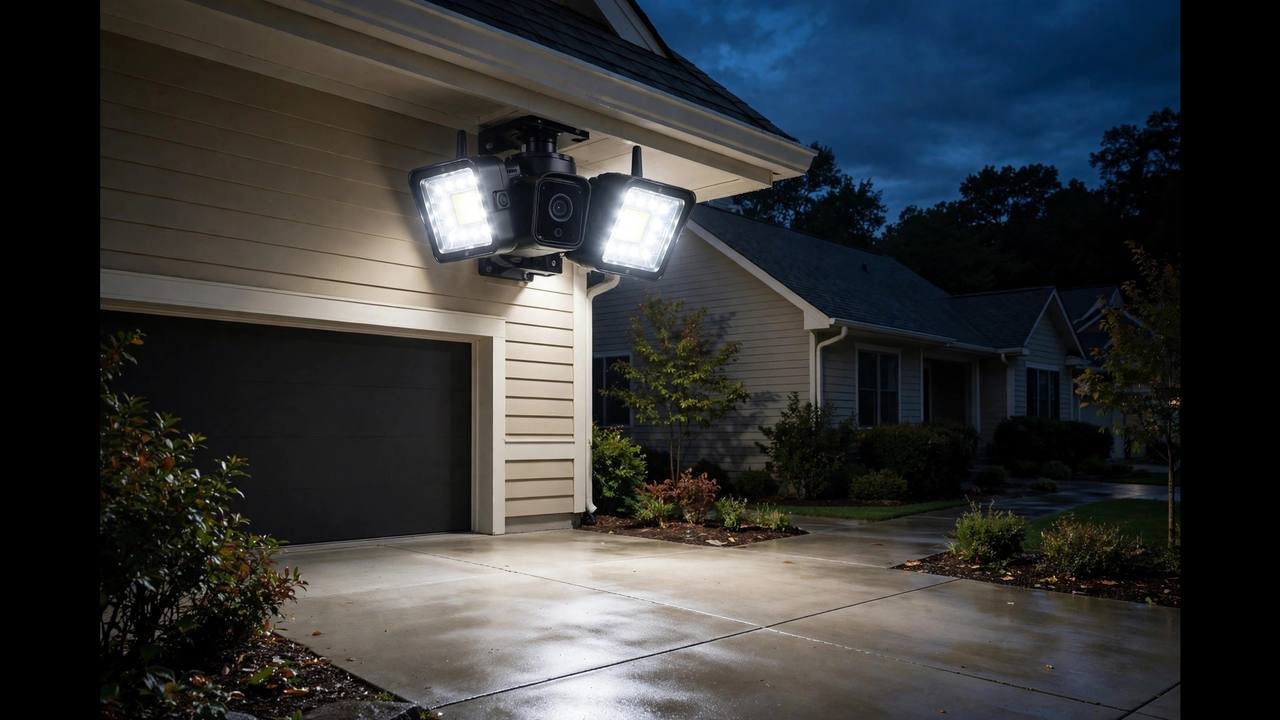
If you’re shopping for the best floodlight camera Australia has to offer in 2026, the short version is this: the Eufy Floodlight Camera E340 is the best all-rounder for most homes, the Ring Floodlight Cam Wired Plus is the cheapest way in, and the Google Nest Cam with floodlight suits households already living in the Google Home app. Prices below were checked in October 2026 against Australian retailers, and I’ll call out the subscription traps and the installation rule most overseas guides never mention.
Why a floodlight camera makes sense for Australian homes
A floodlight camera does two jobs at once: it lights up the area and records what happens in it. That combination matters in Australia more than in many countries. Our blocks are bigger, our side passages are darker, and a surprising number of break-ins happen through back doors and side windows that a doorbell camera never sees.
The light itself is a deterrent. Opportunistic thieves prefer darkness, and a 2000-lumen floodlight snapping on is often enough to send someone looking for an easier target. The camera part means you get usable footage instead of the grainy black-and-white blobs older sensor lights produce.
There’s a catch, though: almost every serious floodlight camera is hardwired to 240V mains power. In Australia that means a licensed electrician must do the installation. It’s not optional, and it’s not a suggestion buried in the manual — it’s the law, and the manufacturers repeat it in their Australian listings. Budget roughly $150 to $300 for the sparky on top of the camera price, depending on how easy the cable run is. Keep that in mind when comparing prices below.
What to look for before you buy
Brightness (lumens). 2000 lumens is the sweet spot for a driveway or backyard. The models in this guide deliver 2000 to 2400 lumens, which is genuinely bright — enough to read a number plate in the lit zone. Dimmable lights are worth having if the camera sits near a bedroom window or close to a neighbour’s fence.
Video resolution. 2K is the minimum I’d accept in 2026. The Eufy E340 goes further with a dual-camera 3K setup. Remember that resolution only helps if the camera can see the subject — mounting height and angle matter as much as megapixels.
Wi-Fi band. Many Australian homes are brick veneer or double brick, which eats 5GHz signals. Several Ring models only use 2.4GHz, which is actually fine — 2.4GHz travels further through walls. The Eufy E340 supports both bands plus Wi-Fi 6, giving you options if your router sits close to the mounting spot.
Storage and subscriptions. This is where the real cost hides. Ring cameras need a Ring Home plan for any video history at all. Eufy’s E340 records to a local microSD card with no monthly fee. Google gives you free event history and charges for more. Decide before you buy whether you’re comfortable with an ongoing fee.
Motion detection quality. Cheap cameras alert you every time a palm frond moves. Look for person detection and customisable activity zones so your phone isn’t buzzing all night.
The best floodlight cameras in Australia for 2026
1. Eufy Floodlight Camera E340 — best overall
Price: $449.95 RRP (eufy.com/au); around $379 at The Good Guys (prices checked Oct 2026).
The E340 is the floodlight camera I’d recommend to most Australian buyers. It pairs two cameras — a 3K wide-angle and a 2K telephoto — with 360-degree pan and tilt and AI subject tracking, so it physically follows a person across your yard. The floodlights put out 2000 lumens and are dimmable, and colour night vision is genuinely good.
What sets it apart in Australia is the lack of a subscription. Footage records to a microSD card (up to 128GB, about six days of continuous recording at top quality) or to a eufy HomeBase 3 if you own one. It supports dual-band Wi-Fi 6, works with Alexa and Google Assistant, and carries an IP65 weather rating — fine for anything short of a cyclone.
The downside is installation: it’s hardwired 240V, so you need a licensed electrician, and at 1.38kg it’s a solid unit to mount. But for the money, nothing else combines this resolution, tracking and zero ongoing fees. If you want to compare eufy’s approach against Arlo’s subscription model in more detail, see our Eufy vs Arlo Australia comparison.
2. Ring Floodlight Camera 2K (2nd Gen) — best for Alexa households
Price: $329 (ring.com/au); around $315 at The Good Guys (prices checked Oct 2026).
Ring’s current-generation floodlight camera records in 2K with colour night vision, 2000-lumen floodlights, 3D motion detection and Bird’s Eye View, which shows you an overhead map of motion paths. Dual-band Wi-Fi is a welcome upgrade over older Ring models that were 2.4GHz-only, and the 110dB siren is loud enough to be heard from the street.
If your home already runs on Alexa — Echo speakers, Fire TV — the integration is seamless. Motion announcements on your Echo, live view on a Fire TV or Echo Show, and routines that turn on other lights when the camera detects a person.
The honest drawback is the subscription. Without a Ring Home plan, you get live view and notifications but no saved recordings, which rather defeats the purpose of a security camera. Factor the ongoing cost into your decision. Ring states plainly that installation and wiring must be performed by a licensed electrician in Australia.
3. Ring Floodlight Cam Wired Plus — best budget pick
Price: $149 (ring.com/au) (prices checked Oct 2026).
At $149, the Wired Plus is the cheapest floodlight camera from a major brand in Australia. You still get 1080p video, 2000-lumen floodlights, colour night vision, a 105dB siren, two-way talk and customisable motion zones with a 140-degree field of view.
1080p is modest by 2026 standards, and Wi-Fi is 2.4GHz only — though as noted, that’s not necessarily a weakness in a brick home. The subscription requirement applies here too: no Ring Home plan, no video history. But if the budget is tight and you want proper brand support and an electrician-friendly standard install, this is remarkable value. For a cheaper wire-free alternative, our guide to the best solar security cameras in Australia covers options that skip the sparky entirely.
4. Google Nest Cam with floodlight — best for Google Home users
Price: $549 RRP; $548 at Harvey Norman (prices checked Oct 2026).
Google’s floodlight camera is the brightest here at 2400 lumens, and its party trick is genuinely smart alerts: it can tell the difference between a person, a vehicle and an animal, and only fires the floodlights for the things that matter. The 1080p HDR video is sharp, and unlike Ring, you get free event video history without paying anything.
The Google Home app experience is polished, and familiar-face detection (opt-in) can tell you when the kids get home versus a stranger at the gate. Nest Aware is optional for longer history and 24/7 recording on Plus.
The price is the obvious hurdle — it’s the most expensive camera here — and it’s wired only, so the electrician rule applies. It’s also white-only, which suits most eaves and fascia boards. If you’re already paying for Nest Aware or deep in the Google ecosystem, it’s the natural pick.
Floodlight cameras compared at a glance
Here’s how the four stack up on the specs that matter:
| Camera | Price (AUD, Oct 2026) | Resolution | Brightness | Subscription needed? |
|---|---|---|---|---|
| Eufy Floodlight Cam E340 | ~$379–$450 | 3K + 2K dual | 2000 lm | No (microSD) |
| Ring Floodlight Cam 2K (2nd Gen) | $329 | 2K | 2000 lm | Yes (Ring Home) |
| Ring Floodlight Cam Wired Plus | $149 | 1080p | 2000 lm | Yes (Ring Home) |
| Google Nest Cam + floodlight | $549 | 1080p HDR | 2400 lm | No (free event history) |
Installation: what Australian law requires
Every hardwired floodlight camera in this guide runs on 240V mains power. Under Australian law, connecting fixed 240V wiring must be done by a licensed electrician — DIY is not legal, and it can void your home insurance if something goes wrong.
The good news: it’s usually a quick job. If you’re replacing an existing outdoor light, the wiring is already there and most sparkies will have the camera up in under an hour. If it’s a fresh cable run through the roof space, expect to pay more. Get the quote before you buy the camera so there are no surprises.
Mounting height matters too. Around 2.5 to 3 metres is ideal — high enough that it can’t be tampered with, low enough that faces are recognisable. Angle the floodlights slightly downward to avoid blasting light into neighbours’ windows, and check your local council rules on light spill if you’re in a dense suburb.
If the electrician requirement puts you off, a wired PoE system installed by a cabler is a different path worth knowing about — see our guide to the best PoE security camera systems in Australia.
Do you actually need a subscription?
Be honest with yourself about this before buying. A floodlight camera without recording is just an expensive light.
Ring’s cameras are the strictest: no Ring Home plan means no video history, period. Google gives you event clips free, which is enough for most people — you get the alert, you watch the clip, you move on. Eufy charges nothing at all for local recording, though you supply the microSD card.
Over three years, a mid-tier subscription can add several hundred dollars to the real cost of a “cheap” camera. That’s why the $149 Ring Wired Plus can end up costing more than the $379 Eufy E340 over its lifetime. Do the maths for your situation, not just the sticker price.
When a floodlight camera isn’t the right choice
Floodlight cameras are excellent, but they’re not for every spot. If you’re renting, a hardwired camera you can’t take with you is a poor investment — a wire-free camera is the smarter buy.
They’re also overkill for indoor use or for monitoring a small courtyard where a compact spotlight camera does the job with a fraction of the light spill. And if your switchboard is old or your outdoor wiring is questionable, the electrician may recommend a board upgrade before adding load — rare, but ask the question when you get the quote.
Finally, think about placement honesty: one floodlight camera covers one area well. A big corner block with a long side passage may need two units, or one floodlight camera at the front and a cheaper wire-free camera at the back. Buy for the property you actually have, not the one in the brochure.
Floodlight camera FAQs
Do I need an electrician to install a floodlight camera in Australia?
Yes, if it is hardwired. Australian law requires fixed 240V wiring work to be done by a licensed electrician. Ring, Google and eufy all state this in their AU installation guidance. Battery or plug-in models can be installed yourself.
Do floodlight cameras need a subscription in Australia?
Ring cameras need a Ring Home plan to save and review recordings. The Eufy E340 records to a microSD card with no subscription. Google Nest Cam includes free event video history, with Nest Aware optional for longer history.
How bright should a floodlight camera be?
Look for 2000 to 2400 lumens for a driveway or backyard. The Eufy E340 and Ring models deliver 2000 lumens, while the Google Nest Cam with floodlight reaches 2400 lumens. Dimmable lights are useful near bedrooms or neighbours.
Will a floodlight camera work on 2.4GHz Wi-Fi?
Yes. Most floodlight cameras, including Ring models, run on 2.4GHz Wi-Fi, which reaches further through brick walls common in Australian homes. The Eufy E340 also supports 5GHz and Wi-Fi 6 for faster live views when the signal is strong.
Our verdict: for most Australian homes, the Eufy Floodlight Camera E340 is the best floodlight camera in Australia for 2026 — no subscription, excellent video, and a street price around $379. Alexa loyalists should get the Ring 2K (2nd Gen); Google households should get the Nest. And whatever you buy, get a sparky to wire it — for the full rundown of wired options, see Ring’s official Floodlight Camera 2K page on ring.com/au for AU specs and install requirements.