
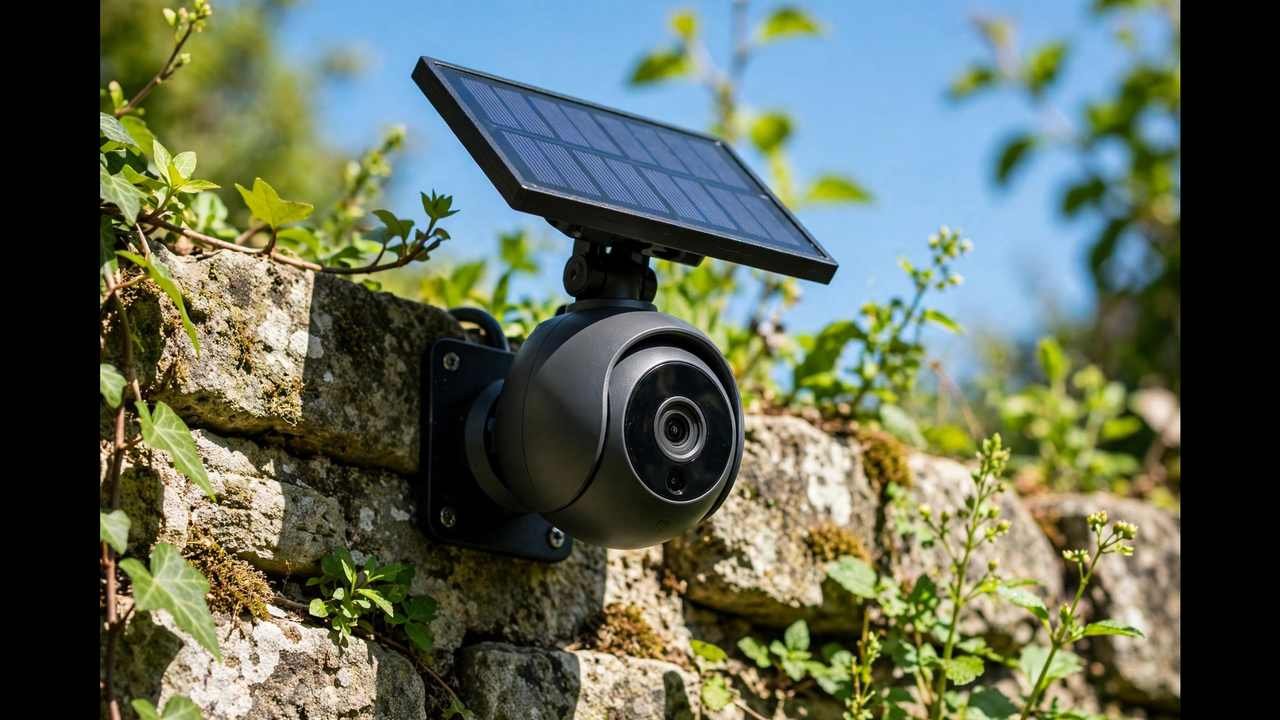
The best solar security camera Australia buyers can get in 2026 is the Eufy SoloCam S340 — a 3K pan-and-tilt camera with an integrated solar panel, no subscription fees, and a street price as low as $299. But solar cameras live or die on sunlight, panel size and placement, and most overseas reviews skip the realities of an Australian winter. This guide covers the four best options with real AUD prices checked in October 2026, plus the honest physics of keeping them charged.
How solar security cameras actually work (and their limits)
A solar security camera is a battery camera with a small photovoltaic panel attached. The panel trickle-charges the battery during the day; the battery runs the camera at night and through cloudy stretches. In a sunny spot in Queensland, the system genuinely runs forever without you touching it. In Melbourne in July, it’s a different story.
The two numbers that matter are panel wattage and battery capacity. The Eufy SoloCam S340 has a 2.2W detachable panel and a 10,000mAh battery — a generous combination. Reolink’s panels are typically 3W to 6W depending on the model. Bigger panel plus bigger battery equals more resilience through a run of overcast days.
What most guides won’t tell you: solar cameras still need Wi-Fi. The panel solves power, not connectivity. If you’re mounting on a back fence 30 metres from the router, through two brick walls, the camera will be charged and useless. Test your Wi-Fi at the mounting spot with your phone before you buy. And in Australia, the panel must face true north (not magnetic north — there’s meaningful variation) to catch maximum sun.
What to look for before you buy
Battery capacity. 10,000mAh or more gives you real buffer. Smaller batteries are fine in the tropics but will have you climbing a ladder in a Victorian winter.
Panel size and adjustability. A detachable, angle-adjustable panel beats a fixed one — you can point the camera at the gate and the panel at the sun, which are rarely the same direction.
Resolution. 2K is the baseline; 3K (like the S340) gives you meaningfully more detail for reading plates or faces at distance.
Storage model. This is the subscription question again. Eufy and Reolink record locally with no mandatory fees. Ring needs a Ring Home plan for video history. Uniden gives free 7-day rolling cloud backup for the life of the product.
Wi-Fi band. Nearly all solar cameras are 2.4GHz-only. That’s fine for range, but if your router is modern and you’ve disabled the 2.4GHz band (or merged SSIDs confuse the setup), check before buying.
Weather rating. IP65 is the minimum for Australian conditions — it handles dust and rain. All four picks here meet or exceed it.
The best solar security cameras in Australia for 2026
1. Eufy SoloCam S340 — best overall
Price: $449.95 (eufy.com/au); $299 at DeviceDeal; $378.35 at Woolworths (prices checked Oct 2026).
The S340 is the standout solar camera in Australia right now. It combines a 3K wide-angle lens with a 2K telephoto lens, 8x hybrid zoom, and 360-degree pan with 70-degree tilt — so one camera covers an area that would need two or three fixed cameras. The 2.2W solar panel is detachable and adjustable, and the 10,000mAh battery means it genuinely runs indefinitely in most Australian locations.
There’s no subscription: footage lives on 8GB of built-in storage (expandable thinking via HomeBase 3 compatibility), with on-device AI for person and vehicle detection. Colour night vision comes from a built-in spotlight. It works with Alexa and Google Assistant.
Caveats: Wi-Fi is 2.4GHz only, and 8GB of internal storage fills faster than a microSD-based camera if your street is busy — pair it with a HomeBase S380 if you want serious retention. At $299 from DeviceDeal it’s exceptional value; even at full RRP it’s fair. For the deeper brand debate, see our Eufy vs Arlo Australia comparison.
2. Reolink Argus 3 Pro — best value
Price: RRP $139.99; seen at $99.95 delivered (OzBargain, Aug 2026); solar panel accessory around $25–$40 (prices checked Oct 2026).
If the S340 is the premium pick, the Argus 3 Pro is the value king. 2K (5MP) video, colour night vision with a spotlight, smart person/vehicle/animal detection, dual-band 2.4/5GHz Wi-Fi, and local microSD storage with no subscription required. The 6000mAh battery is smaller than the S340’s, so the solar panel (sold separately) matters more here — with it attached and decent sun, reviewers report the battery never dropping below 90%.
Reolink’s app is solid, the IP65 body handles Australian weather, and it plays nicely with Google Assistant and Alexa. At roughly a hundred dollars on sale, it’s the cheapest credible solar camera from a real brand. Just budget the panel as a mandatory accessory, not an optional extra, and mount it north-facing.
3. Uniden App Cam SOLO X2K + solar panel bundle — best Australian brand
Price: $183 (was $209) at uniden.com.au (prices checked Oct 2026).
Uniden is the local hero of this list. The SOLO X2K bundle pairs a 2K wire-free camera with the SPS-X solar panel, colour night vision, two-way talk, a siren, and Uniden’s Thermo Sense heat-and-motion detection to cut false alerts. Up to 180 days of operating time is claimed on the battery, and the panel keeps it topped up indefinitely in practice.
The killer feature is the backup model: SD card local storage plus free 7-day rolling cloud backup for the life of the product — no subscription, ever. Support is Australian (1300 366 895), the warranty is two years, and you can buy it knowing the company has been selling into this market for decades.
Video quality is a step behind the S340’s 3K dual-lens setup, and the app is functional rather than beautiful. But at $183 with the panel included, it’s the best-value complete solar kit from an Australian brand. For how Uniden stacks up against the other local favourite, read Swann vs Uniden vs Arlo Australia.
4. Ring Outdoor Camera Plus (Solar) — best for Ring/Alexa households
Price: $189 for the solar bundle (ring.com/au) (prices checked Oct 2026).
If your home already runs Ring doorbells and an Echo ecosystem, staying in the family makes sense. The Outdoor Camera Plus records in 2K with a wide 160-degree view, colour night vision, two-way talk and a remote siren. The solar panel keeps the quick-release battery topped up with a few hours of daily sun.
Setup is genuinely easy, the Ring app is the most polished here, and Alexa announcements (“motion detected at the back door”) work beautifully. The unavoidable trade-off is the subscription: without a Ring Home plan you get live view and alerts but no saved video. Factor that into the real cost.
One Australian-specific note: Ring’s specs warn the camera can temporarily shut down in extreme heat without shade — worth remembering for a north-facing mount in Alice Springs or western Sydney in January. A small eave overhang solves it.
Solar security cameras compared at a glance
| Camera | Price (AUD, Oct 2026) | Resolution | Panel included? | Subscription needed? |
|---|---|---|---|---|
| Eufy SoloCam S340 | $299–$450 | 3K + 2K dual | Yes (2.2W) | No |
| Reolink Argus 3 Pro | ~$100–$140 | 2K (5MP) | No (~$25–40) | No |
| Uniden SOLO X2K bundle | $183 | 2K | Yes (SPS-X) | No (free 7-day cloud) |
| Ring Outdoor Cam Plus (Solar) | $189 | 2K | Yes | Yes (Ring Home) |
Placement tips for Australian conditions
Face the panel true north. In the southern hemisphere, north-facing gets the most sun. Use your phone’s compass in true-north mode, not magnetic. Even a 30-degree error costs meaningful charging in winter.
Watch for seasonal shade. A spot that’s sunny in October can be shaded by the neighbour’s jacaranda in June when the sun sits lower. Think about the winter sun angle, not just today’s.
Keep the panel clean. Dust, pollen and bird droppings cut output more than you’d expect. A wipe every couple of months takes thirty seconds.
Give it Wi-Fi. Test signal strength at the mounting spot before drilling. A $50 Wi-Fi extender near a back window is cheaper than a camera that can’t upload.
Mind the heat. Dark-coloured cameras in direct western sun can exceed their operating temperature (most are rated to 50°C). An eave or small shade helps in the hottest climates.
If you’ve got mains power at the spot and want something brighter with serious deterrence, a hardwired option might suit better — see our guide to the best floodlight cameras in Australia.
Solar vs battery-only vs wired: which power type suits you?
Solar is the middle path between three options, and it’s worth being clear about when it wins. Battery-only cameras (no panel) are cheapest and simplest, but you’ll be climbing a ladder every few months to recharge — fine for a camera above the back door, miserable for one on a far fence. Wired cameras (mains or PoE) never need charging but need an electrician or cabler. Solar costs a little more upfront and then disappears from your life.
Solar wins when the mounting spot gets direct sun for at least a few hours a day and running cable there would be expensive or ugly — back fences, detached garages, side passages, garden sheds. It loses when the spot is permanently shaded (under a deep veranda, under dense trees) or when you need 24/7 continuous recording, which no battery camera does regardless of panel size. Match the power type to the location, not the other way around.
What the spec sheet won’t tell you
“180 days battery life” means standby. Manufacturers quote battery life based on a handful of motion events per day. On a busy street with twenty triggers daily, expect far less — which is exactly why the solar panel matters more than the headline battery figure.
Detection range shrinks at night. The Eufy S340’s PIR detection reaches 6–8 metres by day but only 4–6 metres at night on default sensitivity. Mount accordingly: if the thing you want to detect is 10 metres away, the camera will see it in daylight and may miss it at 2am.
Two-way talk has a delay. All of these cameras route audio through the cloud, so there’s a one-to-two-second lag. Fine for telling a courier to leave a parcel; hopeless for a real conversation.
Software updates can change behaviour. Wire-free cameras get regular firmware updates, and occasionally an update tweaks detection sensitivity or battery management. It’s rarely a problem, but if your camera suddenly behaves differently after an update, check the release notes before assuming it’s faulty.
Solar security camera FAQs
Do solar security cameras work in winter in Australia?
Yes, but expect less charging. In southern states like Victoria and Tasmania, short winter days mean the panel may only top up the battery rather than fully charge it. Face the panel true north, keep it clean, and choose a camera with a large battery (10,000mAh or more) to ride through cloudy stretches.
Do solar security cameras need Wi-Fi?
Most do. Solar solves the power problem, not the connectivity problem. Cameras like the Eufy SoloCam S340 and Reolink Argus 3 Pro connect over 2.4GHz Wi-Fi. If the mounting spot has no Wi-Fi coverage, consider a 4G cellular camera instead.
How long does the battery last on a solar security camera?
With a properly positioned panel in a sunny Australian location, the battery effectively stays topped up indefinitely and you never charge it manually. Without enough sun, most cameras last one to three months on battery alone depending on how often motion triggers recordings.
Can I install a solar security camera myself in Australia?
Yes. Solar cameras are low-voltage devices with no mains wiring, so there is no electrician requirement. Mounting is a simple DIY job with basic tools — the main skill is picking a spot that gets direct sun for most of the day.
Our verdict: the Eufy SoloCam S340 is the best solar security camera in Australia for 2026 — 3K video, pan-and-tilt, integrated panel and zero subscription. On a budget, the Reolink Argus 3 Pro with a panel is unbeatable value; for local support and a complete kit under $200, Uniden’s bundle is the smart Australian buy. Check the manufacturer’s specs before mounting — Reolink’s official Argus 3 Pro page on reolink.com/au lists full AU specs and panel options.