
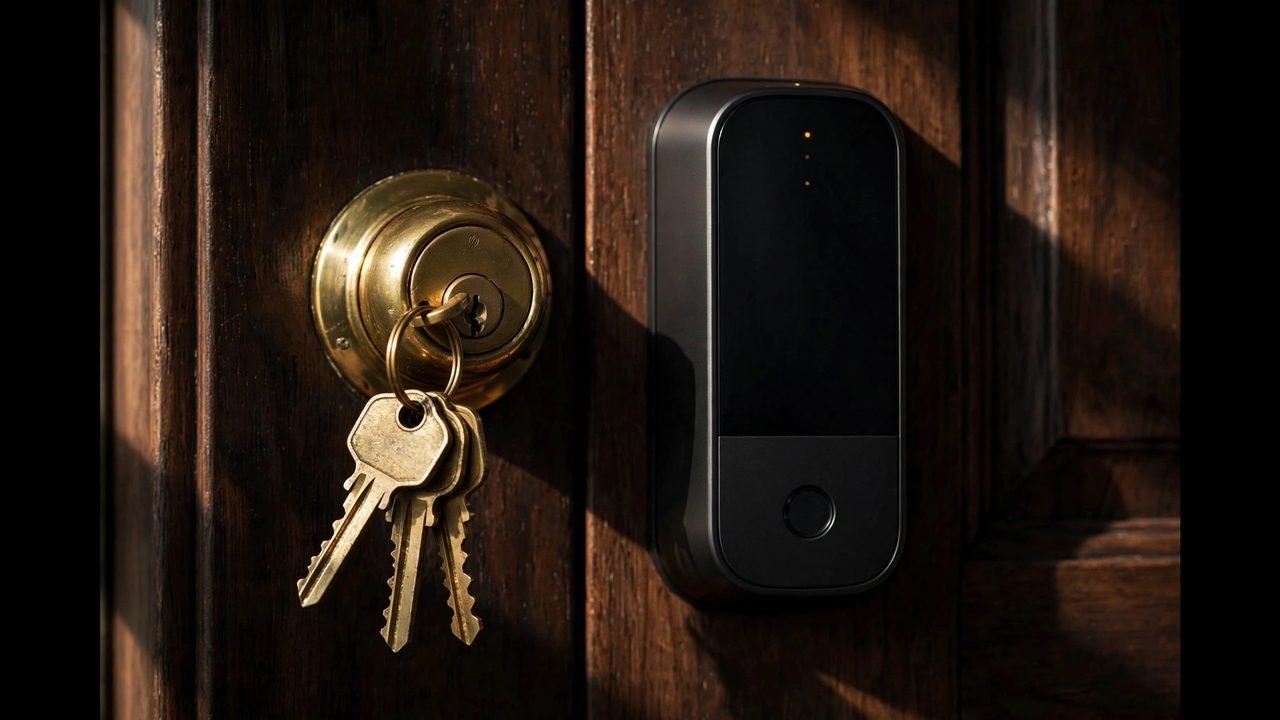
The smart lock vs traditional deadbolt debate tends to attract strong opinions and weak evidence. Smart lock makers will tell you keys are obsolete. Locksmiths will tell you electronics fail. The truth, as usual, sits in the middle — and it depends a lot more on your household than on the technology.
This is an honest comparison written for Australian homes: real prices from Australian retailers (checked October 2026), the Australian lock standard that actually matters, and clear guidance on who should buy which.
The short answer
Get a smart lock if you regularly need to let people in when you’re not home, lose keys, run an Airbnb, or want to know who’s coming and going. Keep or buy a traditional deadbolt if you want the cheapest reliable option, distrust anything with an app, or have household members who struggle with technology. Either way, the door and frame matter more than the lock — a $700 smart lock on a flimsy hollow-core door is security theatre.
Smart lock vs traditional deadbolt: head to head
| Feature | Smart lock | Traditional deadbolt |
|---|---|---|
| Entry method | PIN, fingerprint, app, RFID, key | Physical key only |
| Lost-key risk | None — delete the code, not the lock | Rekey or replace ($20-$60+) |
| Guest access | Temporary codes, scheduled access | Cut a key and hope it comes back |
| Remote control | Yes (Wi-Fi models) | No |
| Activity log | Yes — who unlocked, when | No |
| Power needed | Yes — batteries (6-12 months typical) | No |
| Upfront cost (AU) | $195-$740+ | $50-$150 |
| Installation | DIY for retrofit; pro for mortise ($150-$250) | DIY or $100-$150 locksmith |
| Hackable | Theoretically | No — but pickable/bumpable |
Smart lock pros: what you actually gain
No more key problems
This is the big one, and it’s bigger than it sounds. Lost keys, keys locked inside, keys lent to a tradie three years ago who still has them — a smart lock deletes this entire category of problem. Kids get a fingerprint or PIN instead of a key to lose. When a cleaner or dog walker no longer needs access, you delete their code in ten seconds instead of asking for a key back and wondering if they copied it.
Guest and tradie access without the key dance
Anyone who’s run an Airbnb, managed a rental, or just had a plumber coming “between 9 and 2” knows the key handover shuffle. Smart locks turn it into a text message: here’s your code, it works today 9am-3pm, then it stops. No lockbox, no hidden key under the mat (burglars check the mat first — always), no driving across town.
You can check the door from anywhere
Left for the weekend wondering if you locked up? Wi-Fi smart locks answer that in the app and let you lock remotely. Parents of teenagers get an activity log showing when the door was used. It’s a modest feature that owners consistently say becomes the one they use most.
Auto-lock fixes human forgetfulness
A surprising number of break-ins involve an unlocked door, not a defeated lock. Most smart locks auto-lock after a set time, closing the most common security gap in any home: people.
Smart lock cons: the honest downsides
Batteries are your new chore
Every smart lock runs on batteries — typically 4 to 8 AAs lasting 6-12 months. They all warn you well in advance, and they all have a backup (physical key, 9V jump contacts, or USB-C emergency power). But it is a maintenance task that doesn’t exist with a deadbolt, and if you ignore the warnings for a month, you will eventually stand on your own porch at 11pm holding a 9V battery to your door like an idiot. Ask how we know.
More things that can go wrong
Apps need updates. Bluetooth pairing drops. Wi-Fi bridges want to be on 2.4GHz while your router steers everything to 5GHz. None of this is fatal, but a smart lock is a small computer bolted to your door, and small computers occasionally need attention. If everyone in the house finds smartphones stressful, a smart lock will be stressful too.
The security trade-off is real (but misunderstood)
Smart locks add a digital attack surface that deadbolts don’t have. In practice, though, burglars overwhelmingly use force (kicked doors, broken windows) or stolen/copied keys — not Bluetooth exploits. The realistic security question isn’t “can it be hacked?” but “is the mechanical lock underneath any good?” Cheap no-name smart locks sometimes pair fancy electronics with flimsy hardware. Buy the lock for its mechanical rating first (AS4145.2 in Australia), electronics second.
They cost 3-5x more
A decent traditional deadbolt is $50-$150. The cheapest worthwhile smart lock is about $195 (Orion Grid Connect at Bunnings); the good ones run $400-$740. If all you need is a lock that locks, that’s a lot of money for convenience features you’ll never use.
Traditional deadbolt pros: the case for keeping it simple
The deadbolt’s virtues are all about what it doesn’t do. No batteries, no apps, no accounts, no firmware, no Wi-Fi passwords to remember. It works in a blackout, in a flood, in 20 years exactly the way it works today. Anyone — a grandparent, a housesitter, a firefighter — understands it instantly.
It’s also cheap and proven. A quality Australian deadbolt from a known brand, properly installed with a reinforced strike plate and decent screws into the frame, is genuinely hard to defeat quietly. Lock picking and bumping work on cheap cylinders, but a good restricted-keyway deadbolt resists both well.
And for the security-paranoid (affectionate), there’s something to be said for an attack surface of zero. No cloud account to breach, no Bluetooth to sniff, no app permissions to audit.
Traditional deadbolt cons
Keys are the whole problem. They get lost ($20-$60 to rekey each time, more for restricted systems), copied without your knowledge (any shopping-centre key cutter, no questions asked), and lent out and never returned. After a breakup, a falling-out with a housemate, or buying a house from strangers, the only safe move is rekeying every external lock.
There’s no audit trail — you can’t tell who came in or when. There’s no remote anything. And the most common failure mode is human: people simply forget to lock deadbolts. A deadbolt only protects you when it’s thrown, and studies consistently show a large share of burglaries involve unlocked entry points.
Security: which is actually harder to break into?
Here’s the framing that cuts through the marketing: burglars are lazy and opportunistic. The Australian Bureau of Statistics and insurer data consistently show most break-ins are through unlocked doors/windows or by force — kicking, jemmying, smashing. Sophisticated lock defeat, digital or mechanical, is rare.
Against that reality:
- A good deadbolt, properly installed (solid door, reinforced strike, 75mm screws into the stud) resists force well and can’t be hacked. Its weakness is the key: copied, stolen, or left under the mat.
- A good smart lock (AS4145.2-rated hardware, reputable brand, encrypted comms) resists force equally well and eliminates the key problem entirely. Its weakness is complexity: batteries, software, and the small chance of a digital attack.
The lock matters less than most people think; the door, frame, and whether it’s actually locked matter more. Whichever you choose, spend the extra $20 on a reinforced strike plate and long screws. That’s the highest-value security purchase in this entire article.
Cost comparison in Australia
Real numbers, checked October 2026:
- Traditional deadbolt: $50-$150 for a quality unit, plus $100-$150 for locksmith installation if you don’t DIY. Rekeying later: $20-$60 per lock.
- Budget smart lock: under $200 (Orion Grid Connect at Bunnings), DIY install.
- Mid-range smart lock: $419-$499 (Lockwood 001 Touch Plus, Aqara U100), DIY-able for deadlatch/deadbolt types.
- Premium smart lock: $469-$740 (Yale Unity, Yale ByYou D Pro), plus $150-$250 locksmith labour for mortise-style fitting.
Ongoing costs are minimal either way: a set of AA batteries once or twice a year for the smart lock ($10-$15), versus the occasional rekey for the deadbolt. No reputable smart lock brand charges a subscription for basic locking.
See our smart lock installation cost guide for the full DIY-vs-locksmith breakdown.
Insurance and Australian standards: read this before you buy
Australian home insurance policies generally require “deadlocks” on external doors — the exact wording varies, but insurers expect locks meeting Australian Standard AS4145.2. Here’s what to check:
- Certification: Yale Unity and Lockwood 001 Touch Plus are tested to AS4145.2:2008. Many imported smart locks carry only US ANSI/BHMA ratings. An uncertified lock probably won’t void your policy on its own, but in a disputed claim it’s a complication you don’t need.
- Fire doors: If your front door is fire-rated (common in apartments), the lock must be too. The Yale Unity carries a 2-hour fire rating to AS1905.1-2015. Fitting a non-rated lock to a fire door can breach building compliance — check with your strata.
- Discounts: some insurers offer small premium reductions for monitored smart security systems. A smart lock alone rarely qualifies, but bundled with cameras and an alarm it might — ask your insurer before buying, not after.
A note for renters and strata owners
If you rent, the smart lock vs deadbolt question is usually decided for you: most leases prohibit changing locks without written landlord permission, and strata by-laws can restrict changes to fire-rated front doors in apartments. The workaround is a retrofit smart lock that clamps over your existing lock without modifying anything — the Nuki and SwitchBot both work this way. You get the smart features without touching the landlord’s hardware, and you remove it at move-out. Our renter’s guide to smart locks covers the options that won’t cost you your bond.
If you own in a strata building, check your by-laws before replacing a front-door lock, especially on fire-rated doors. The lock’s fire rating must match the door’s — this is one area where the Yale Unity’s 2-hour rating genuinely matters.
The verdict: who should buy which
Buy the smart lock if you: lose keys, host on Airbnb, need tradie/cleaner access, want entry logs, or have kids old enough for a PIN but young enough to lose everything. Our best smart lock Australia guide covers the models worth buying.
Keep the deadbolt if you: want the cheapest reliable option, distrust connected devices, have a household that struggles with apps, or rent (in which case read our renter-friendly smart lock guide — most full smart locks need landlord permission).
Consider both: plenty of Australian homes run a smart lock on the front door for daily convenience and keep a traditional deadbolt on a side or back door as the no-fail fallback. There’s no rule that says you must pick one technology for the whole house.
Frequently asked questions
Are smart locks safer than traditional deadbolts?
In practice, yes for most households. Traditional deadbolts are vulnerable to picked, bumped or copied keys — the most common real-world attack. Smart locks remove the key entirely but add battery and software dependence. An AS4145.2-certified smart lock with a mechanical key backup gives you the best of both.
Can smart locks be hacked?
Theoretically, yes — any connected device can be attacked. In reality, documented break-ins via smart lock hacking are vanishingly rare compared to forced entry or key copying. Stick to reputable brands with encrypted connections and regular firmware updates, use strong unique passwords, and enable two-factor authentication.
Do smart locks work if the battery dies?
Most give weeks of low-battery warnings first. If batteries do die, nearly all models have a backup: a physical key override, external 9V battery contacts, or a USB-C emergency power port. Check which backup your model has before you need it.
Will a smart lock affect my home insurance in Australia?
Insurers generally want locks meeting AS4145.2. Replacing a certified lock with an uncertified import could complicate a claim, so check your policy first. Some insurers discount monitored smart security — ask before buying.
Can I have both a smart lock and a deadbolt?
Yes — many homes use a smart lock on the front door and a traditional deadbolt on side or back doors. Just make sure every external door has a working lock that meets your insurer’s requirements.
Prices checked October 2026 from Bunnings, CHOICE and Australian specialist retailers.
Independent testing reference: CHOICE’s review of the Lockwood 001 Touch Plus includes lab-tested battery, usability and security notes from Australia’s consumer advocacy organisation.