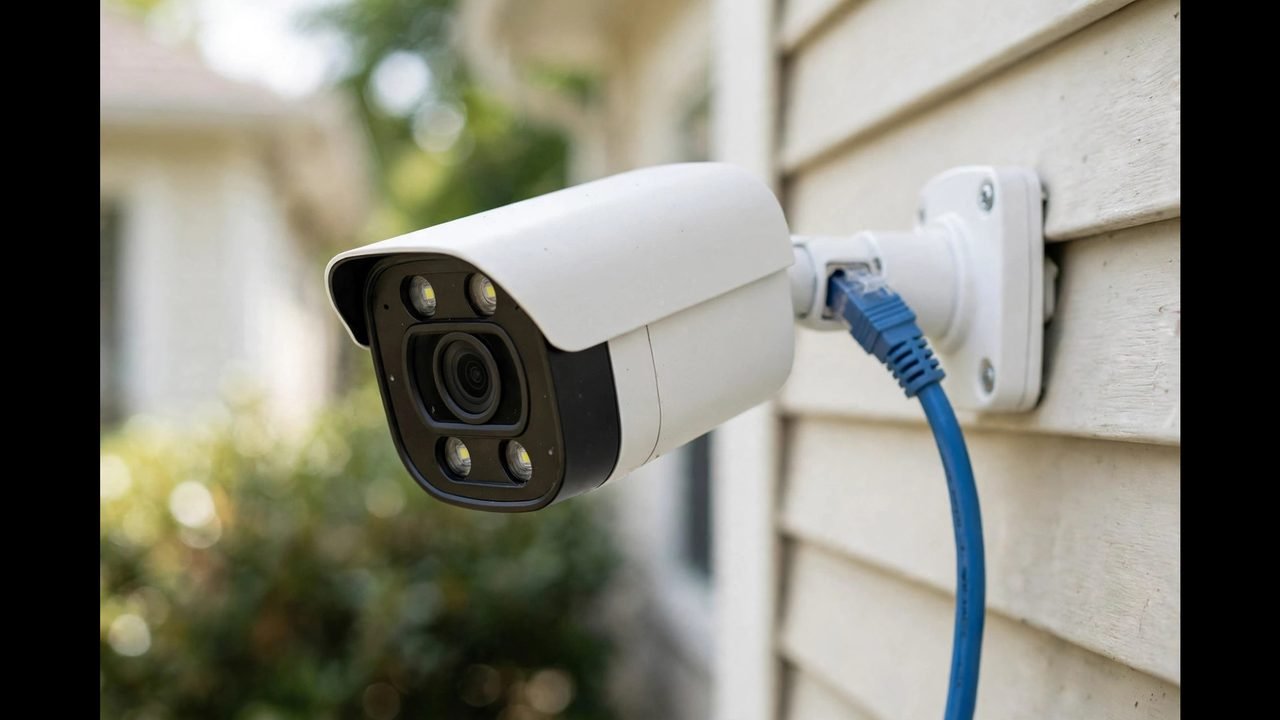
The best PoE security camera system Australia buyers can get in 2026 depends on your property size, but the sweet spot for most homes is a 4-camera 4K kit with an 8-channel NVR — hardware from roughly $1,300 to $1,700. PoE (Power over Ethernet) is the professional’s choice: one cable per camera carries power and data, there’s no Wi-Fi to drop out, no batteries to charge, and you get true 24/7 recording to a hard drive in your home. This guide compares the best kits with real Australian prices checked in October 2026, plus the installation rule that catches DIYers out.
What PoE is and why it beats Wi-Fi for multi-camera setups
PoE sends electrical power and network data down a single Ethernet cable (Cat5e or Cat6). Each camera plugs into the NVR (network video recorder) — or a PoE switch connected to it — and just works: always powered, always connected, always recording.
Compare that to a Wi-Fi camera system. Every Wi-Fi camera needs a power source (battery, solar or a nearby outlet), competes for your router’s bandwidth, and can drop offline when the microwave runs or the NBN has a bad day. One or two Wi-Fi cameras are fine. Four to eight of them, all streaming to the cloud, will make you wish you’d run cable.
PoE’s other big win is 24/7 continuous recording. Battery cameras record motion clips to save power; a PoE system with a 2TB hard drive records everything, all the time, for weeks. When something happens at 3am and the motion sensor missed it, continuous footage is the difference between evidence and nothing.
What to look for before you buy
Channels. An 8-channel NVR with 4 cameras included is the sweet spot — you get whole-house coverage now and room to add cameras later without replacing the recorder. Avoid 4-channel NVRs unless you’re certain you’ll never expand.
Resolution. 4K (8MP) is worth it for PoE because the wired connection handles the bandwidth easily. 4K lets you digitally zoom into a face or plate after the fact. Budget kits at 5MP are fine for general coverage.
Hard drive size. 2TB is standard and holds roughly 2–4 weeks of continuous 4K recording from four cameras (H.265 compression helps a lot). Look for NVRs that support upgrading to 8TB+ later.
Built-in PoE ports. Most kits include an NVR with 8 PoE ports built in — true plug-and-play. If you buy cameras and NVR separately, you’ll need a PoE switch too.
Night vision type. Infrared gives black-and-white night footage with long range (30–40m). Colour night vision (spotlight-based) gives colour but shorter range. For driveways and perimeters, IR range matters more; for entry points, colour is nicer.
App and remote access. All the kits here offer phone apps for live view and playback. Check recent app reviews — a great camera with a terrible app is a daily frustration.
The best PoE security camera systems in Australia for 2026
1. Swann 4K PoE 8-channel 4-camera kit — best for most homes
Price: $1,399.95 (au.swann.com, model SWNVK-886804FB); similar Swann 4K 8-channel kits around $1,499 at specialist retailers (prices checked Oct 2026).
Swann is the default recommendation for PoE in Australia for good reason: it’s a Melbourne-born company with 35+ years in security, its kits are stocked at Bunnings and JB Hi-Fi, and support is local. This kit gives you four 4K bullet cameras with True Detect heat-sensing motion detection (far fewer false alerts than pixel-based detection), an 8-channel NVR with 2TB storage, and IP66 weatherproofing.
Everything’s in the box including Ethernet cables, and the NVR’s built-in PoE ports make it genuinely plug-and-play once the cables are run. The Swann Security app handles live view, playback and alerts. Note it was showing out of stock on Swann’s own AU site at the time of checking — Bunnings, JB Hi-Fi and CCTV specialists usually carry equivalent kits, so shop around. For the brand story, see our Swann vs Uniden vs Arlo comparison.
2. Reolink RLK8-811B4-A 4K spotlight PoE kit — best smart features
Price: $1,299.99 (reolink.com/au) (prices checked Oct 2026).
Reolink’s 8-channel kit pairs four 4K cameras with built-in spotlights for colour night vision, 5x optical zoom on some variants, and person/vehicle detection. The 2TB NVR is expandable, and Reolink’s app is among the best in the PoE world — clean, fast, and reliable for remote viewing.
Reolink’s edge is flexibility: the NVR plays well with Reolink’s Wi-Fi and battery cameras too, so you can mix a wired PoE core with a wire-free camera on the shed where cable can’t reach. No subscription is required for any of it. If you want the smartest PoE kit rather than the most Australian one, this is it.
3. Swann NVR-8580 4K kit via CCTV specialists — best for bigger properties
Price: $1,499 (sale) at everythingcctv.com.au, RRP $1,699.95 (prices checked Oct 2026).
Australian CCTV specialists like Everything CCTV sell Swann’s pro-oriented kits with proper installation support — worth considering if you want the kit supplied and installed by the same people. The NVR-8580-based 8-channel 4K system with four thermal-sensing bullet cameras, 2TB HDD and 40m IR night vision is built for larger blocks where camera-to-NVR cable runs are long and reliability matters.
Buying through a specialist costs a little more than a big-box retailer, but you get pre-sales advice on camera placement and cable planning, which is genuinely valuable on a complex property. Ask for a quote including installation — many will do the whole job.
4. TP-Link VIGI 4-camera 8MP kit — best budget PoE
Price: around $350 for the kit hardware (prices checked Oct 2026).
If $1,300+ makes your eyes water, TP-Link’s VIGI range brings PoE within reach of a tight budget. An 8MP (4K-class) 4-camera kit with H.265+ compression and IP67 cameras for around $350 is remarkable value — roughly the price of a single premium Wi-Fi camera.
The compromises: you’ll need to supply your own NVR or recorder setup thinking, the app ecosystem isn’t as polished as Swann or Reolink, and local retail availability is spottier. But for a shed, workshop or rental property where you want wired reliability cheap, it’s a legitimate option. Just make sure you understand what’s in the box before ordering.
5. Kogan 8-channel NVR 6-camera PoE kit — best camera count for the money
Price: listed as “Don’t Pay $918.98” (Dick Smith/Kogan marketplace) (prices checked Oct 2026).
Six 8MP cameras, an 8-channel NVR and a 4TB hard drive for under a thousand dollars is the most hardware per dollar in this guide. Kogan’s marketplace kits suit buyers who are comfortable with a more hands-on setup and a lesser-known support chain.
Be realistic about what you’re getting: the cameras and software won’t match Swann or Reolink for detection smarts or app polish, and warranty support goes through the marketplace rather than a local security company. But if your priority is maximum coverage on minimum budget — say, a small business or a large rural block — six cameras beat four.
PoE systems compared at a glance
| Kit | Price (AUD, Oct 2026) | Cameras | Resolution | Storage |
|---|---|---|---|---|
| Swann 4K 8ch 4-cam (SWNVK-886804FB) | $1,399.95 | 4 (8ch NVR) | 4K | 2TB |
| Reolink RLK8-811B4-A | $1,299.99 | 4 (8ch NVR) | 4K | 2TB |
| Swann NVR-8580 kit (specialist) | $1,499 | 4 (8ch NVR) | 4K | 2TB |
| TP-Link VIGI 8MP kit | ~$350 | 4 | 8MP | BYO recorder |
| Kogan 8ch 6-cam kit | ~$919 | 6 (8ch NVR) | 8MP | 4TB |
Installation in Australia: the cabler rule you need to know
Here’s what no overseas guide tells you: in Australia, any data cabling run through walls, ceilings or floors must be installed by an ACMA-registered cabler. PoE uses Ethernet data cabling, so it counts. Doing it yourself can attract an on-the-spot fine of $1,320, or up to $13,200 if prosecuted. This isn’t theoretical — it’s the same rule that governs NBN and network cabling.
In practice, most buyers do one of three things. Option one: hire a cabler or CCTV installer to run the cables — typically a few hundred dollars for a straightforward single-storey home, more for double brick or two storeys. Option two: run the cables yourself surface-mounted along eaves, fences or conduit — no wall cavities involved, no cabler required, and it looks tidy if done carefully. Option three: buy the kit from a CCTV specialist who supplies and installs it as one job.
Total installed cost for a typical residential PoE system in Australia runs $2,000 to $3,500 including hardware, cabling and labour. Get two quotes; installers vary wildly. And put the NVR somewhere secure and ventilated — a locked cupboard near the router is ideal — plus a small UPS so recording survives short blackouts.
If the cabling sounds like too much, wire-free cameras are the alternative — our best solar security cameras guide covers options with no cables at all, and the best floodlight cameras guide covers hardwired single-camera options.
PoE vs Wi-Fi: which should you choose?
Choose PoE if: you’re covering four or more cameras, you want 24/7 continuous recording, you own the property, your NBN Wi-Fi is already stretched, or you want the most reliable system possible. Choose Wi-Fi if: you’re renting, you need one or two cameras, you can’t run cable, or you want the cheapest and simplest install.
There’s also a middle path many Australian homes end up with: a PoE NVR core covering the house perimeter, plus a wire-free or solar camera on the back shed or side gate where cable can’t reasonably go. Reolink’s NVRs handle this mix natively, and it’s often the most practical answer for an awkward block.
Maintenance: the unglamorous part nobody mentions
A PoE system is lower-maintenance than any battery camera, but it’s not zero-maintenance. Hard drives wear out — budget for a replacement every 3–5 years (a 2TB surveillance-rated drive is around $100–$150). Check camera lenses for spider webs every few months; one web across an IR camera at night turns your footage into a glowing blur. And keep the NVR’s firmware updated — most can auto-update overnight.
The other maintenance item is the UPS battery. A small UPS protecting your NVR costs under $150 and its battery needs replacing every 2–3 years. Set a calendar reminder. A PoE system that dies in every blackout is only slightly better than no system, and storm-season outages are exactly when you want cameras running.
PoE security camera FAQs
Can I install a PoE security camera system myself in Australia?
You can mount the cameras and plug in pre-made cables yourself, but any cabling run through walls, ceilings or floors must be installed by an ACMA-registered cabler under Australian law, with on-the-spot fines of $1,320 for non-compliance. Surface-mounted cable runs are a common DIY-friendly alternative.
How much does a PoE security camera system cost in Australia?
A 4-camera 4K PoE kit costs roughly $1,300 to $1,700 for the hardware in Australia. Professional installation typically brings a full residential setup to $2,000–$3,500 depending on cable runs and property size. Budget kits start around $350 for the hardware alone.
Is PoE better than Wi-Fi for security cameras?
For multi-camera setups, yes. PoE delivers power and data over one cable with no batteries to charge, no Wi-Fi dropouts, and support for 24/7 continuous recording. Wi-Fi cameras are easier to install and better for renters or single-camera spots.
Do PoE cameras work during a power outage?
Only if the NVR and network switch are on a UPS (uninterruptible power supply). A small UPS keeping the NVR alive for an hour or two is cheap insurance and standard practice for serious setups.
Our verdict: for most Australian homes, a Swann 4K 8-channel PoE kit is the safest buy — local company, local support, no subscriptions, and shelf stock everywhere. Reolink’s RLK8-811B4-A is the pick if you want smarter detection and a better app. Either way, budget for a registered cabler if cables go through walls, put the NVR on a UPS, and you’ll have a system that just works for years — the ACMA’s cabling provider rules explain exactly what’s required.