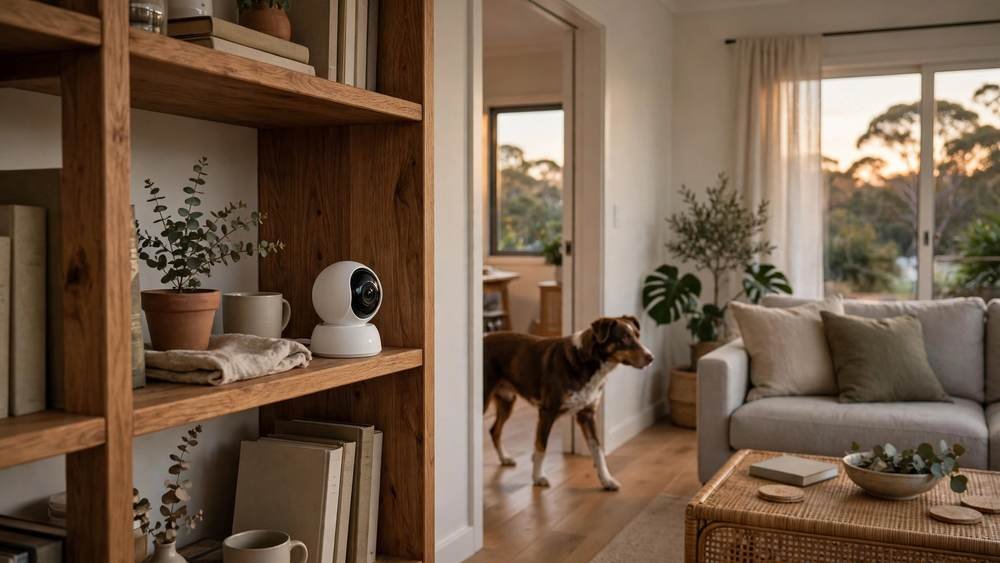
You ask your indoor camera to tell you when a person walks in — and to ignore the dog. That is the promise behind indoor camera with AI human pet tracking, and it is also the query more Australians are typing into Google. But “AI” on the box covers everything from a camera that genuinely recognises your dog to one that alerts on every curtain movement. This guide to indoor camera AI pet tracking Australia explains how the technology actually works, what it costs month to month, and which of five cameras available in Australia — prices verified on 5 November 2026 — suits your house.
Short version: for most Australian homes, the right indoor camera AI pet tracking Australia setup is a pan-and-tilt camera with on-device detection and no subscription. The Eufy Indoor Cam E220 at $139.95 is the pick for most people, the Reolink E1 Pro at $98.99 is the pick if you want footage to stay in your house, and Google Nest is the pick only if you are happy paying monthly for familiar face recognition.
Indoor camera with AI human pet tracking: what the phrase actually means
The phrase bundles three features. Human detection means the camera can tell a person apart from a moving curtain or a pet, and only alert you for people. Pet detection is the same idea for animals — the camera knows the dog is on the couch and either alerts you or stays quiet. Tracking means the camera follows the movement: pan-and-tilt models physically swing the lens to keep a person or pet in frame.
Most indoor cameras sold in Australia claim at least one of the three; few do all three well. What matters is whether detection is free or behind a subscription, whether it runs inside the camera or on a faraway server, and how often it gets the answer wrong.
How AI detection actually works
A basic motion sensor is dumb. It compares one video frame with the next, and any change in pixels — a curtain, a sunbeam, a ceiling fan — counts as motion.
AI detection adds a classification step before the alert goes out. The camera, or a cloud server, looks at the shape that moved and asks what it is: person, pet, vehicle, or none of those. Only a match for a category you care about becomes a notification. Some cameras add sound detection for barking, meowing, a baby crying, or glass breaking.
Tracking is a separate mechanism. Pan-and-tilt cameras swing the lens to follow a person or pet. A fixed camera can only crop digitally into what it already sees. Detection models are trained mostly on adults standing upright and common pets, so a crawling toddler or a very small dog can be missed, and dim rooms or backlight make classification worse. AI cuts false alerts dramatically, but it does not eliminate them.
On-device AI vs cloud AI: where the thinking happens
For indoor camera AI pet tracking Australia shoppers, the first decision is not the brand — it is whether the thinking happens in the camera or in the cloud. It decides whether you pay monthly, whether detection works offline, and where your footage travels.
On-device AI runs the detection model on a chip inside the camera. Eufy, TP-Link Tapo and Reolink all do this for person and pet detection, and they do not charge for it. Detection keeps working if your NBN drops out.
Cloud AI sends the video to the manufacturer’s servers, which run a larger model. Google Nest and Arlo work this way for their smartest features — familiar face recognition and richer event summaries live here. The downside is the monthly bill, and your footage travels to a data centre every time something moves. If you hate subscriptions, buy on-device; if you want the cleverest recognition and do not mind paying monthly, buy cloud.
The 5 cameras, compared on their AI
| Camera | AI type | Human / pet detection | Tracking | Subscription for AI | Price (Nov 2026) |
|---|---|---|---|---|---|
| Eufy Indoor Cam E220 | On-device | Human, pet, audio, crying | Pan & tilt | None | $139.95 |
| TP-Link Tapo C225 | On-device | Person, pet, vehicle, bark/meow | Pan & tilt | None (cloud optional) | See note below |
| Reolink E1 Pro | On-device | Human, pet, crying | Pan & tilt, auto-track | None (cloud optional) | $98.99 |
| Google Nest Cam Indoor (3rd gen) | Cloud | Person, vehicle, animal; familiar faces | Fixed view | Google Home Premium | $189 |
| Arlo Essential 2K Pan Tilt | Cloud | Person, vehicle (with plan) | Pan & tilt | Arlo Secure | $68 |
1. Eufy Indoor Cam E220 — the no-subscription AI pick
Around $139.95 at eufy.com AU. The E220 is on-device AI done well: 2K video, pan and tilt with auto-tracking, and human and pet AI with no monthly fee. It also detects crying, records to a microSD card, and supports Apple HomeKit. If your main interest is watching pets rather than security, our best indoor camera for pets guide compares the pet-focused options.
2. TP-Link Tapo C225 — the free-AI budget pick, with an availability warning
The C225 is the cheapest way into AI detection: 2K QHD, 360-degree pan, person, pet and vehicle detection, all free, with microSD storage and a privacy shutter. The catch is Australian availability. PB Tech lists it at $88.67 but showed it out of stock on 5 November 2026, and it previously sold for around $44 at The Good Guys (October 2026). At around $45–$90 it is a bargain; at $199 it is not.
3. Reolink E1 Pro — the privacy-first pick
Around $98.99 at The Tech Geeks Australia, in stock. The E1 Pro is the camera for people who want footage to stay in the house: 4MP video, 355-degree pan with auto-tracking, person, pet and crying detection on the device, with microSD storage up to 512GB or a Reolink NVR. It also supports RTSP and NVR integration. Its AI list is shorter than Eufy’s, but for person and pet alerts with no monthly fee, it is the most privacy-friendly option here.
4. Google Nest Cam Indoor (3rd generation) — the smartest detector, with a monthly bill
Around $189 at JB Hi-Fi, in stock. The third-generation wired Nest Cam is the most capable detector here and the only one with familiar face recognition: with a Google Home Premium subscription it learns the faces of people in your household. The trade-off: it is a fixed camera — no pan or tilt — and the smartest features sit behind that subscription (Standard A$15 a month or A$150 a year; Advanced A$30 a month or A$300 a year). Without a plan you get live viewing and three hours of event clips only.
5. Arlo Essential 2K Pan Tilt — the cheapest pan-and-tilt camera, with a catch
Around $68 at Harvey Norman, in stock (listed as saving $50). Arlo’s pan-tilt indoor camera gives you 2K video and full 360-degree room coverage, with person and vehicle detection and activity zones. The catch is the same as Nest’s: those features need an Arlo Secure plan after the 30-day trial, from $8.33 a month, with the Plus tier at $16.67 a month. Without a plan you get live view and basic motion alerts only. Buy it if you are happy paying monthly; if not, Eufy or Reolink give you the same coverage.
False alerts: the honest reality
Every AI camera here will still send you a wrong alert sometimes. The usual culprits: curtains moving in a breeze, a ceiling fan, sunlight shifting across the floor, and the television flickering.
Three settings fix most of it. First, activity zones: draw a box around the doorway, the hallway or the pet’s bed and tell the camera to ignore everything outside it. They are the most effective false-alert control, supported by Nest, Eufy and Arlo. Second, person-only alerts: if you only care about people, turn pet alerts off. Third, sensitivity and placement: put the camera at roughly chest height, facing into the room rather than at a window. Backlight is the most common cause of missed detections.
What indoor camera AI pet tracking Australia costs every month
Here is what each camera costs over three years, using the subscription prices verified on 5 November 2026.
| Camera | Camera price | Monthly AI cost | 3-year total |
|---|---|---|---|
| Eufy Indoor Cam E220 | $139.95 | $0 | $139.95 |
| Reolink E1 Pro | $98.99 | $0 | $98.99 |
| TP-Link Tapo C225 | Varies (see note) | $0 | Camera price only |
| Arlo Essential 2K Pan Tilt | $68 | From $8.33 | About $368 |
| Google Nest Cam Indoor (3rd gen) | $189 | From $15 | About $729 |
The Nest is a better detector than the Eufy, but over three years it costs roughly five times as much once the subscription is counted — $729 against $139.95. Our security camera subscription costs compared guide breaks down every major brand side by side.
Privacy: where your footage actually goes
An indoor camera films the most private rooms in your house, so where the footage goes matters. With on-device AI (Eufy, Tapo, Reolink), detection happens inside the camera and video only leaves your home if you choose cloud backup. With cloud AI (Nest, Arlo), the video travels to the manufacturer’s servers whenever something moves.
Three habits cover most of the risk. First, use the physical privacy shutter where one exists — the Tapo C225 has a lens cover, Arlo’s indoor camera an automated shield — and shutter it while you are home. Second, tell the people in the house a camera is running and where it points. Third, do not point the camera at a neighbour’s home, and keep it out of bedrooms and bathrooms. The OAIC notes individual-operated cameras are not covered by the Privacy Act, but state and territory surveillance laws may still apply — read the OAIC’s guidance before aiming a camera near a boundary. Our security camera laws Australia guide has more detail.
No manufacturer is breach-proof: use a unique password, turn on two-step verification, and keep the firmware updated.
Renters vs owners: which AI setup suits you
Renters should buy plug-in, shelf-sitting cameras and nothing that needs a drill. All five are plug-in, but the on-device ones suit renting best: no subscription to cancel when you move, no wiring to undo, and you take the camera and its microSD card with you.
Owners have two extra options. The first is mounting: a camera fixed high in a corner sees more of the room. The second is a recorder: the Reolink E1 Pro can feed an NVR or a home server, giving you 24/7 recording with no cloud bill. If you own and want whole-house coverage, one pan-and-tilt camera per main living area, all recording locally, beats five cloud cameras each charging monthly.
Setting up indoor camera AI pet tracking Australia so it works
Five steps, in order, make the difference between a camera that helps and one that spams you.
- Place it at chest height, facing into the room. A camera on a bookshelf sees people the way the AI was trained to; one near the ceiling sees the tops of heads.
- Keep windows out of frame. Backlight turns people into silhouettes — angle the camera away from the window.
- Draw activity zones on day one. Cover the doorway and the pet’s bed; exclude the television and curtains.
- Turn on person-only alerts first. Add pet alerts once person alerts are clean. Adding everything at once makes it impossible to tell which category is misfiring.
- Test it like a burglar and a dog. Walk through at normal speed, then send the dog through. Check the alert named the right category and the clip is watchable. If it failed, change one thing and test again.
Frequently asked questions
Can an indoor camera really tell a human from a pet?
Yes, within limits. Cameras classify the shape that moved before alerting, so a person and a dog produce different alerts — or the dog produces none, if that is how you set it. Accuracy is best in good light at chest height.
Do I need a subscription for AI human and pet detection?
Not always. Eufy, TP-Link Tapo and Reolink include person and pet detection free on the camera. Google Nest and Arlo put their smartest detection behind paid plans — Google Home Premium from A$15 a month, Arlo Secure from $8.33 a month in Australia.
Does AI tracking work without the internet?
On-device AI keeps detecting when the internet drops, because the classification runs inside the camera. Cloud AI stops detecting entirely without internet. If your NBN is unreliable, buy on-device.
Is it legal to have an indoor camera that watches people in my home?
Generally yes inside your own home, but never record in bedrooms or bathrooms, tell people in the house that cameras are running, and do not film a neighbour’s private areas. The OAIC notes individual-operated cameras are not covered by the Privacy Act, but state and territory surveillance laws may still apply.
Which indoor camera with AI tracking is best for renters in Australia?
For indoor camera AI pet tracking Australia renters, the Eufy Indoor Cam E220 at $139.95 is the best fit: plug-in, no drilling, no subscription, pan-and-tilt tracking with on-device human and pet AI.