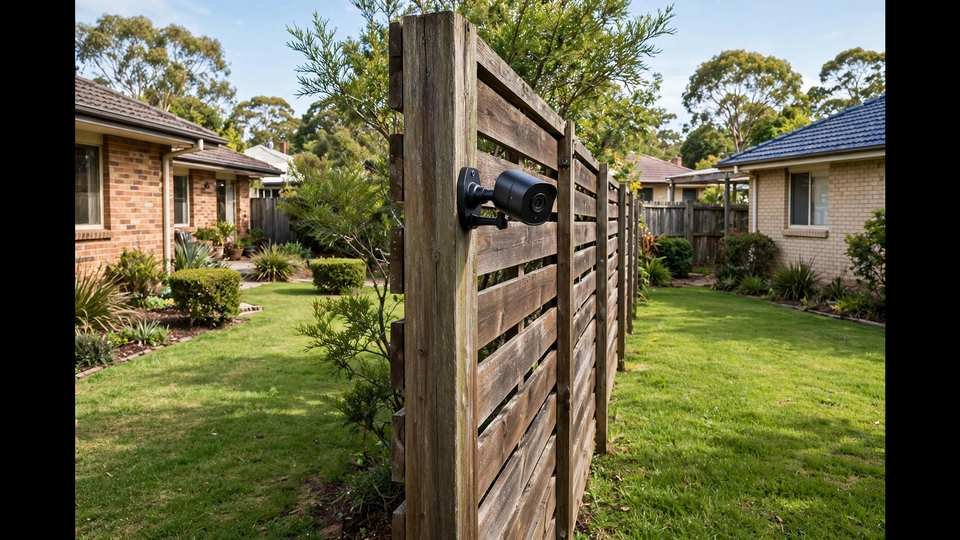
Security camera laws in Australia catch more homeowners off guard than almost any other part of buying a system. The price, the placement, the storage — that’s the easy part. The hard part is the legal line between protecting your property and infringing on someone else’s privacy, and in Australia that line is drawn differently in every state and territory.
Here’s the framework in plain English: there is no single national law governing home security cameras. Instead, each state and territory has its own surveillance devices legislation, and they don’t all say the same thing. Add in the stricter rules around audio recording, the special cases of strata buildings and rentals, and the question of what you can do about a neighbour’s camera pointed at your backyard, and you have a topic worth understanding before you drill a single mount.
Important: this is general information about security camera laws in Australia, not legal advice. The law also changes — if you’re in a genuine dispute, talk to a solicitor who knows your state’s legislation.
The Big Picture: What Australian Law Actually Says
Three facts surprise most people:
- There is no general right to privacy in Australian law. Unlike some countries, Australia has no broad legal right to not be filmed. Your protections come from specific legislation, not a general principle.
- The federal Privacy Act 1988 generally doesn’t cover private homes. The Privacy Act applies to government agencies and larger businesses — not to a homeowner’s private CCTV. That means the Office of the Australian Information Commissioner (OAIC) has limited power over your neighbour’s camera setup, though its guidance on privacy is still worth reading at oaic.gov.au.
- Video and audio are treated very differently. Pointing a camera at your own driveway is broadly fine everywhere. Recording the audio of your neighbours’ conversations is restricted or outright illegal in most states without consent. This is the distinction that causes the most trouble, because many modern cameras record sound by default.
The core principle across all states: you may install cameras on your own property to monitor your own property. Problems start when cameras deliberately capture other people’s private spaces, or when they record private conversations.
State-by-State: The Legislation That Applies to You
New South Wales — Surveillance Devices Act 2007
Section 8 makes it an offence to knowingly install, use or maintain an optical surveillance device (a camera) where doing so involves entering someone else’s premises without consent, or interfering with someone else’s property without consent. The maximum penalty is five years’ imprisonment and/or an $11,000 fine for an individual — $55,000 for a company. Note what the Act does not do: it doesn’t prohibit you from installing a camera on your own property that happens to record a neighbouring property. But using a camera to stalk or harass someone can separately fall under the Crimes (Domestic and Personal Violence) Act 2007.
Victoria — Surveillance Devices Act 1999
Victoria’s Act makes it an offence to record or observe a private activity without consent — and a neighbour in their own backyard counts. The maximum penalty for an individual is two years’ imprisonment or a substantial fine. This is one of the stricter regimes: in practice, a camera that records a neighbour’s private outdoor space without their consent is on the wrong side of the line. Keep cameras within your own boundary.
Queensland — Invasion of Privacy Act 1971
Queensland handles this under older legislation. It’s an offence to use a listening device to record private conversations without consent, and there are restrictions on optical surveillance where it involves trespass. As elsewhere, cameras on your own property monitoring your own property are fine; deliberately filming a neighbour’s private areas is not.
Western Australia — Surveillance Devices Act 1998
Section 6 is the key provision. Notably, WA guidance (including the City of Canning’s published information sheet for residents) confirms that no permission is required to install cameras on your own residential property — not from police, neighbours, or council — and signage is not legally required. However, cameras should be aimed at your own property, and audio recording is tightly restricted: you cannot record a private conversation unless all parties consent.
South Australia — Surveillance Devices Act 2016
SA’s relatively modern Act prohibits the use of optical surveillance devices to record private activities without consent, and listening devices to record private conversations without consent. Party consent rules apply to audio.
Tasmania, ACT and Northern Territory
Tasmania’s Listening Devices Act 1991 and the territory equivalents (the Listening Devices Act 1992 in the ACT; the Surveillance Devices Act 2007 in the NT) follow the same pattern: video on your own property is broadly permitted; recording private conversations without consent is restricted; trespass to install devices is prohibited. If you’re in a territory, check the current version of the Act — these are smaller jurisdictions where the legislation is amended less often but still binding.
The pattern across all eight: video of your own property = fine. Deliberate video of a neighbour’s private spaces = risky or illegal. Audio of private conversations = restricted almost everywhere.
Audio Recording: The Rule That Trips Everyone Up
This deserves its own section because it’s the single most common legal mistake with home cameras. Most modern security cameras — Ring, Arlo, Eufy, Swann — have microphones, and many ship with audio recording switched on.
In most Australian states, recording a private conversation without the consent of the parties is an offence under the relevant surveillance devices or listening devices Act. “Private conversation” generally means a conversation where the participants have a reasonable expectation it won’t be overheard or recorded — which absolutely includes neighbours chatting in their own backyard.
Practical guidance:
- Disable audio recording on outdoor cameras unless you have a specific reason to keep it and understand your state’s consent rules.
- If you keep audio on, check whether your state requires one-party or all-party consent — WA, for example, effectively requires all parties to consent.
- Two-way talk features (like a video doorbell’s speaker) are different from continuous audio recording, but the recorded clips those doorbells save can still include audio — check your settings.
- Disabling audio doesn’t weaken your security in any meaningful way. Video is what identifies intruders and supports insurance claims; audio almost never does.
Neighbours: Where the Line Is and What to Do About Their Camera
Your obligations toward neighbours
Aim cameras at your own property. Where a neighbour’s property appears at the edge of frame as an unavoidable side effect of covering your boundary, that’s generally treated as incidental capture — not ideal, but not the same as deliberate surveillance. Deliberately aiming a camera at a neighbour’s backyard, windows, or pool area without their consent is where you cross into breach territory in most states.
Simple steps that prevent nearly all disputes: angle cameras to minimise neighbour capture, use your camera’s privacy masking feature to black out neighbouring windows and entertaining areas in the recording, and — underrated — tell your neighbours you’re installing cameras. Our placement guide shows how to angle cameras for full coverage without catching next door.
Signage is worth considering even where it’s not legally required (in WA, for instance, the City of Canning confirms no signage is legally required for residential cameras). A small “CCTV in operation” sign costs a few dollars, signals that your intent is security rather than snooping, and doubles as a deterrent — which is half the point of visible cameras anyway.
What to do about a neighbour’s camera pointed at you
If you believe a neighbour’s camera is infringing on your privacy, work through these steps in order:
- Talk to them first. Most people don’t realise their camera catches your yard. A calm conversation — “I think your side camera picks up our back deck; any chance you could angle it down a touch?” — resolves the majority of cases.
- Put it in writing. If talking doesn’t work, a polite written request creates a record. Keep copies.
- Check strata or council rules. If you’re in a strata scheme, the owners corporation may have by-laws about cameras on common property. Some councils publish guidance (like the City of Canning’s information sheet) that you can reference.
- Seek mediation. Every state has a community justice or dispute resolution centre that handles neighbour disputes cheaply or free.
- Get legal advice. If the camera deliberately records your private spaces and the neighbour won’t budge, a solicitor can advise whether the conduct breaches your state’s surveillance devices Act — and the police can investigate where an offence may have occurred.
What generally won’t help: the OAIC (the federal Privacy Act usually doesn’t cover private homes), or demanding the footage — there’s no general right to access someone else’s private CCTV recordings.
Renters, Strata and Shared Walls
Renters can generally install cameras inside their rental and at entry points, but anything fixed to the exterior usually needs the landlord’s written permission — check your lease. Wireless, no-drill options avoid most of this. Note that a landlord’s own cameras in common areas of a share house raise their own privacy questions; cameras inside bedrooms or bathrooms are never acceptable regardless of who owns the property.
Strata and body corporate: cameras on your lot (inside your apartment, your balcony) are generally your business. Cameras on common property — hallways, lobbies, car parks — are the owners corporation’s decision, and footage from common-property cameras is subject to strata record-keeping rules. If your camera captures common property, check your scheme’s by-laws first.
Can Camera Footage Be Used as Evidence?
Yes — with caveats. Australian courts routinely admit CCTV footage in criminal and civil matters, and police actively seek it out; residential CCTV has become integral to burglary investigations in many areas. But footage obtained illegally (for example, by trespassing to install the camera, or audio recorded in breach of listening-device laws) can be challenged or excluded.
If you capture an incident: preserve the original file, export the minutes before and after the event, make sure the timestamp is correct, and give police the unedited original rather than a compressed social-media copy. And call 000 if an offence is in progress; otherwise use your state police’s non-emergency or online reporting channel. Our guide on whether cameras deter burglars covers how footage actually helps investigations — and where its limits are.
Frequently Asked Questions
Is it legal to have a security camera pointed at my neighbour’s house in Australia?
Deliberately aiming a camera at a neighbour’s private spaces (backyard, windows, pool) without consent can breach state surveillance devices laws — in Victoria it’s an offence to record a private activity without consent. Incidental capture at the edge of frame while covering your own boundary is treated differently, but you should minimise it with camera angles and privacy masking.
Can my neighbour record audio from their security camera in Australia?
In most states, recording private conversations without consent is an offence under surveillance devices or listening devices legislation — WA, for example, effectively requires all parties to consent. If your camera records audio by default, the safest setting for outdoor cameras is audio off.
Do I need a sign if I have security cameras in Australia?
Signage is not legally required for residential cameras in most states — WA’s City of Canning guidance explicitly confirms no signage is required there. However, a “CCTV in operation” sign is still good practice: it signals your intent is security, can help in disputes, and acts as a deterrent.
What can I do about my neighbour’s security camera in Australia?
Start with a calm conversation — most neighbours don’t realise their camera catches your property. If that fails, put your request in writing, check strata by-laws or council guidance, try community mediation, and seek legal advice if the camera deliberately records your private spaces in breach of your state’s surveillance devices Act.
Does the Privacy Act 1988 cover home security cameras?
Generally no. The federal Privacy Act 1988 applies to government agencies and larger businesses, not private homeowners’ CCTV. Home camera disputes are handled under state and territory surveillance devices legislation, which is why the rules differ depending on where you live.
Sources
- City of Canning (WA) — Compliance Information Sheet: Surveillance Cameras on Residential Property (government guidance): canning.wa.gov.au
- Sydney Criminal Lawyers — Surveillance cameras in NSW neighbourhoods (Surveillance Devices Act 2007, s 8): sydneycriminallawyers.com.au
- Office of the Australian Information Commissioner — privacy guidance: oaic.gov.au
- Castle Security — What can I do about my neighbour’s security cameras: castlesecurity.com.au