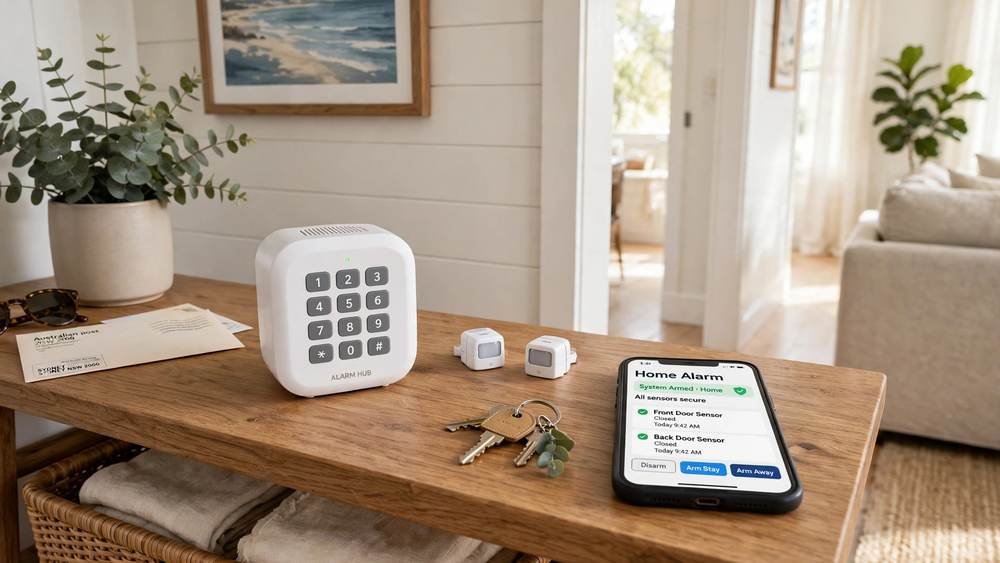
Shopping for a wireless alarm system Australia homeowners can install themselves gets confusing fast, because most guides mix up three things: the alarm panel that runs a professionally installed system, the camera kit that records video, and the wireless kit in between. This guide is about the third one — hub, sensors, siren, and app. No cables, no installer booking, no monthly bill unless you choose one.
Every price below comes from Australian listings checked on 6 November 2026; where a price could not be verified in Australia, the article says so instead of guessing. US prices are labelled as US prices — because Ring Alarm and SimpliSafe, the two best-known wireless alarm names in the world, are not officially sold in Australia.
What is in a wireless alarm system Australia kit
A wireless alarm system is a small set of battery-powered parts that talk to each other by radio instead of by cable. The box usually holds four things.
The hub is the brain. It plugs into power and your router, listens to every sensor, and sounds the siren or sends the alert. Eufy calls theirs the HomeBase, Ajax the Hub, Ring the Base Station. It must stay powered and connected, so its backup battery matters most.
The sensors are the eyes and ears. Entry sensors are two small magnets that report when a door or window opens. Motion sensors watch a room. Most kits start with one motion sensor and two entry sensors, which covers a front door, a back door and one living area — and not much else.
The keypad is how you arm and disarm at the door with a PIN, instead of opening the app every time; a key fob does the same from your keys. If the kit has no keypad, check the price of adding one first. The siren is the noise: a loud indoor siren makes an intruder leave, a quiet hub beep does not. The Ring base station has a 104 dB siren built in; eufy’s 105 dB siren is separate, and an outdoor siren is usually extra.
How the parts talk to each other
Wireless does not mean Wi-Fi. Most alarm sensors use a low-power radio link to the hub, not your home Wi-Fi — Ajax uses its encrypted Jeweller protocol on 868 MHz, Ring sensors use Z-Wave. A sensor that talks directly to the hub keeps working when your router is off: Ajax quotes batteries up to 7 years and a range of up to 2,000 metres in open field, though walls cut that down sharply indoors.
The hub uses your internet, usually by Ethernet or Wi-Fi, and the better hubs add a cellular SIM as a second path — the difference between an alarm that keeps reporting during an outage and one that goes silent. Without cellular backup it can still sound its siren locally, but it cannot send anything to your phone. Check whether app arming needs a subscription: without one, Ring only allows keypad arming and sends no phone notification, while eufy includes phone alerts and app arming free.
Wireless alarm system Australia prices
Here is what you can actually buy in Australia right now, prices verified on 6 November 2026. The honest headline: the cheapest well-known wireless kit is sold out at its own Australian store.
| Kit or part | What you get | Price (Nov 2026) | Notes |
|---|---|---|---|
| eufy Security 5-in-1 Alarm Kit | HomeBase 2, keypad, motion sensor, 2 entry sensors | $349.95 | Listed on eufy AU store; sold out at check time |
| eufy Entry Sensor | Door/window contact | $49.00 | In stock, eufy AU |
| eufy Motion Sensor | PIR motion detector | $49.99 | In stock, eufy AU |
| eufy Security Siren (105 dB) | Wireless siren | $79.95 | In stock, eufy AU |
| eufy Key Fob E10 | Arm/disarm from keys | $39.99 | In stock, eufy AU |
| Bosch Solution 3000 kit | Hybrid panel, 2 wireless detectors, touchscreen, IP module | $1,533.78 | One listed configuration, CTC |
| Hills Reliance XR / XR Pro | Hybrid panel kits | $445.08 / $607.86 | Panel only, before sensors and install |
| Ajax StarterKit | Hub, motion sensor, door sensor, key fob | Quote only | Installer-quoted in Australia; no published kit price |
Kit prices exclude installation unless stated. The US store lists the same 5-piece kit at US$259.99, which is not an Australian price. Confirm price and stock on the retailer page before buying.
The eufy kit is the cheapest proper wireless alarm system Australia buyers can get from a major brand, and it is sold out on eufy’s own Australian store while its individual sensors are still in stock. If you cannot wait for restock, the parts are sold separately — but a self-built bundle costs more than the kit, and the keypad and indoor siren were also sold out at check time.
At the other end sit the hybrid panels. The Bosch Solution 3000 and Hills Reliance XR are professional panels that take wired and wireless sensors together, cost more, and are usually sold installed. They are the answer when a wireless-only kit runs out of room — a Bosch 3000 handles 16 zones, a Hills XR up to 128. Our best home alarm system guide compares them in detail — read it before you buy a wireless kit you will outgrow in a year.
Ajax is the third option, and the hardest to price: a professional wireless system sold in Australia through installers such as Smokeshield and Alltronic, with encrypted wireless signalling, outdoor detectors, and a hub battery of up to 15 to 16 hours. There is no published Australian kit price — installers quote after a site assessment. Compare it against eufy on what is included once you have the quote in hand.
The big names you cannot buy in Australia
Search for wireless alarm kits and the first names you meet are Ring Alarm, SimpliSafe, Arlo and Yale Sync. Three of the four are not officially sold here — knowing that saves you from a grey import with no local support and no Australian monitoring.
Ring Alarm is the biggest one. The 5-piece kit — base station with a 104 dB siren and 24-hour backup battery, keypad, contact sensor, motion detector and range extender — lists at US$199.99 on Ring’s site, with the 8-piece at US$249.99 and the 14-piece at US$329.99. But Ring states the Alarm is available and ships only within the US and Canada. There is no Australian kit, no Australian Ring Protect plan, and no local support. An imported kit may power on, but its monitoring does not work here.
SimpliSafe is the same story: starter kits from around US$245, monitoring from around US$20 a month in the US, but no Australian store, no Australian monitoring, and no local retailer. Any SimpliSafe price in Australian dollars is a conversion, not a local price. Yale Sync is a UK alarm, from £229, and Yale’s Australian range covers smart locks and the Connect Plus hub, not the Sync alarm. Arlo is the partial exception: its cameras and doorbells are sold widely in Australia, but the Arlo Home Security System is a US product at US$199.99 for the starter kit and US$299.99 with five sensors, with no Australian listing found.
What a wireless alarm system costs all-in
The kit price is the smallest part of the decision. A wireless alarm system Australia buyers should budget for has three costs — hardware, installation, and monitoring — and only the first is on the box.
Hardware for a DIY wireless kit runs roughly $150 to $700, depending on how many sensors your house needs. A unit with two doors might be covered by a single 5-piece kit; a three-bedroom house usually needs extra entry sensors at around $49 each and possibly a second motion sensor. Count your openings first: every external door, every vulnerable window and sliding door, and the main living area.
Installation is free if you do it yourself — stick the sensors up, scan them into the app, and you are armed within the hour. Professional installation labour for a wired or hybrid system runs roughly $300 to $1,000, and installed packages commonly land between $1,500 and $5,000 once panel, sensors, labour and setup are combined. If you are comparing a $349.95 DIY kit against a $1,533.78 Bosch kit, remember the Bosch figure is one listed kit price, not an installed price.
Monitoring matters more than the kit. Self-monitoring costs nothing: the hub alerts your phone and you decide what to do — but if you are asleep, overseas, or out of coverage, nobody else is watching, and a self-monitored system with no cellular backup cannot alert you during an internet outage. Back-to-base monitoring runs roughly $25 to $60 a month, patrol plans roughly $80 to $130, and activation and call-out charges are often extra. Over three years, a $40-a-month plan costs $1,440. Providers generally require the system to meet the alarm standard AS/NZS 2201.2, so a cheap import may not be connectable. Our alarm panel guide covers the tiers and the questions to ask.
Power cuts and internet outages
A wireless alarm system has two weak points: power and internet. The sensors run on batteries, so they keep working in a blackout. The hub needs power, and its backup battery decides how long the system stays alive: Ring’s base station carries a 24-hour backup, the Ajax Hub up to 15 to 16 hours, and the eufy HomeBase has none.
Internet outages are the bigger risk, because they are more common than blackouts. A hub that reports only over broadband cannot send anything while the modem is down; a hub with a cellular SIM keeps reporting. When you compare kits, ask two questions: does the hub have a backup battery, and does it have a cellular path? If both are no, the system is a local siren with a phone app, not a monitored alarm. One Australian check: the 3G shutdown. Australia’s carriers have retired 3G, so any older communicator that depends on it can no longer send signals — mostly an issue for older installed panels, not new wireless kits, but check the communicator before paying for monitoring on a second-hand hub.
Choosing a wireless alarm system by house size
Count openings, not rooms. A unit or small two-bedroom home usually needs one kit: front door, back door, one motion sensor in the living area. A three- or four-bedroom home typically needs the starter kit plus two or three extra entry sensors for vulnerable windows and the sliding door, plus possibly a second motion sensor. Beyond that — large homes, sheds on the same system, a home business — you are in hybrid-panel territory.
Wireless kits are the natural fit for renters and established homes: nothing is screwed into a wall, sensors stick on with adhesive, the hub sits on a shelf, and the system moves with you. Range matters more than the box admits: a sensor in a detached shed or at the far end of a long house may need a range extender, a separate purchase on most systems. Leave a spare sensor in the budget — a system at full capacity on day one has nowhere to grow. Alarms and cameras are different purchases — a camera records what happened, an alarm tries to stop it happening — and our camera cost guide covers the camera side.
Four mistakes to avoid: buying a kit that is not sold here; comparing kit prices without counting sensors; ignoring the hub’s backup; and buying the cheapest no-name kit with no Australian warranty.
Frequently asked questions
Is a wireless alarm system reliable in Australia?
Yes, for most homes. Sensors use low-power radio links to the hub, not your Wi-Fi, so they keep working when the router is off, and batteries last years. Check the hub’s backup battery and cellular path before you buy.
How much does a wireless alarm system cost in Australia?
A DIY wireless kit runs roughly $150 to $700 for equipment, with the eufy 5-in-1 kit listed at $349.95 on its Australian store. Extra sensors cost around $49 each; back-to-base monitoring runs roughly $25 to $60 a month.
Can I install a wireless alarm system myself?
Yes. Sensors stick on with adhesive, the hub plugs into power and your router, and the app walks you through pairing. Professional installation is only needed for wired or hybrid panels, or for back-to-base monitoring.
Does a wireless alarm system work in a power cut?
The sensors do, because they run on batteries. The hub depends on its backup: Ring’s base station carries 24 hours, the Ajax Hub up to 15 to 16 hours, and the eufy HomeBase has none.
Is Ring Alarm available in Australia?
No. Ring Alarm is sold in the US and Canada only, and its monitoring does not work in Australia. The US 5-piece kit lists at US$199.99, which is not an Australian price.
Prices checked 6 November 2026 from Australian listings: the eufy AU store for the 5-in-1 kit and sensors, and CTC Communications for Bosch and Hills figures. Ring, Arlo, SimpliSafe and Yale prices are from the manufacturers’ own US or UK pages and are labelled as such. External price source: eufy AU alarm systems.