
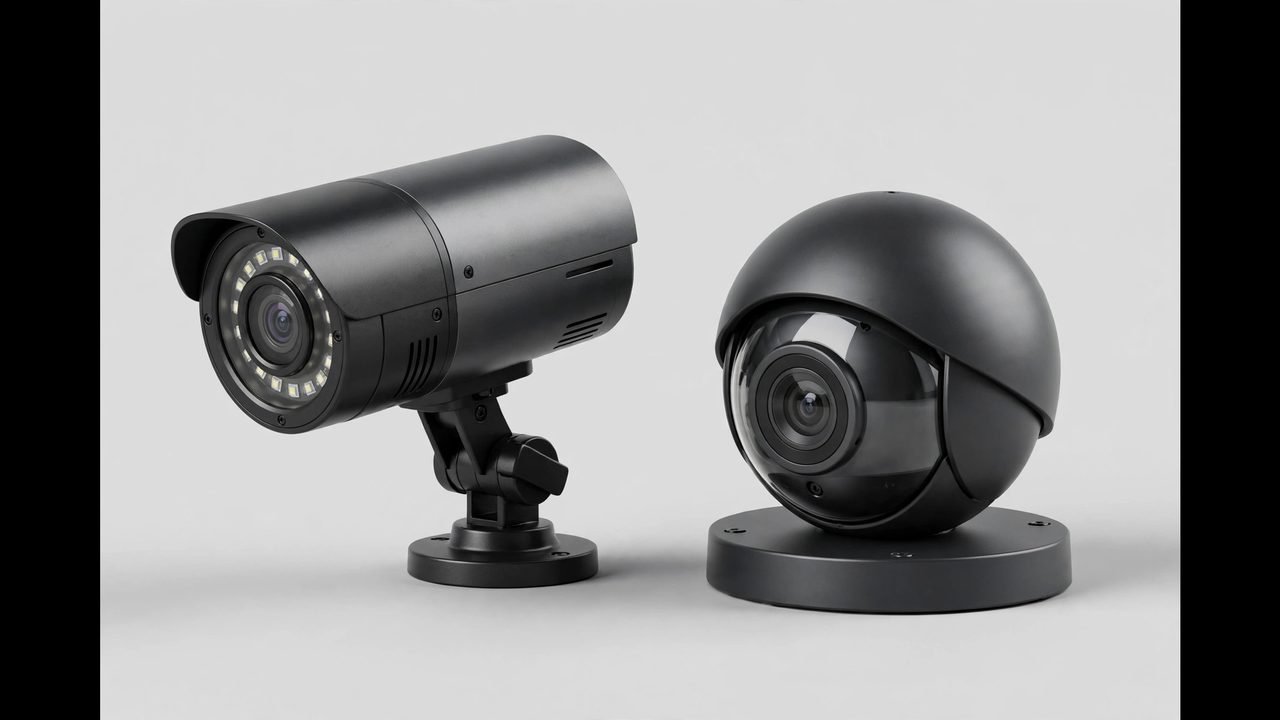
If you’re trying to work out what a home security camera system costs in Australia, the answers vary wildly — from a couple of hundred dollars to well over five grand. That’s because “security camera system” means very different things: a single video doorbell from JB Hi-Fi, or eight wired 4K cameras installed by a licensed technician.
This guide pins down the real 2026 cost of a home security camera system in Australia, broken into parts so you can see where your money actually goes: the hardware, the installation labour, the cabling, and the ongoing costs most guides quietly skip — the cloud subscriptions that can quietly add $600 to $1,500 over five years. By the end you’ll know what a fair quote looks like, what you can safely cut, and what’s false economy.
Quick Answer: What Does a Home Security Camera System Cost in Australia?
Here’s the short version before we unpack the detail:
- Single doorbell or one-camera DIY kit: $150–$400, no installation cost
- 2-camera DIY wireless system: $300–$800
- 4-camera professionally installed wired system: $1,800–$2,100 is the typical sweet spot; quotes range $1,200–$3,800 depending on the city and spec
- 6–8 camera 8MP system, professionally installed: $3,300–$5,300
- DIY multi-camera kit (you install it): $500–$1,000 for the hardware alone
- Ongoing costs: $0 (local recording) to $15–$60/month for monitored alarms or cloud storage plans
Those ranges come from published 2026 pricing guides from Australian installers in Perth, Melbourne and Brisbane, plus retail pricing from JB Hi-Fi and Bunnings. They’re GST-inclusive, since that’s how Australian retailers and installers must quote. Note that installation alone usually accounts for roughly half the total of a professionally installed system — a figure worth remembering when a quote looks steep.
The Two Ways to Buy: DIY Wireless vs Professional Wired
Almost every cost discussion starts here, because the choice between a do-it-yourself wireless setup and a professionally installed wired system is the single biggest driver of what you’ll pay — and what you’ll live with afterwards.
DIY / consumer-grade cameras (Ring, Arlo, Eufy, Swann)
These are the brands on the shelves at JB Hi-Fi and Bunnings. A basic two- or three-camera kit runs $300–$800; more advanced wireless systems with smart-home features and multiple cameras can push past $2,500. They’re battery or plug-in powered, connect over your home Wi-Fi, record motion clips rather than continuous footage, and mostly push recordings to the cloud.
Upfront, DIY looks cheap. The catch is the subscription. Most of these brands only give you limited (or zero) video history without a monthly plan — and those plans are priced per device or per household. As a preview: a typical Ring or Arlo household subscription adds $600–$780 over five years. Eufy is the notable exception — its cameras record to local storage with no subscription required.
DIY suits renters, light use, or one or two spots (front door, driveway). They’re less suited to whole-property coverage: batteries need charging, Wi-Fi gets flaky at the far corners of a block, and motion-only recording can miss the start of an incident.
Professional / wired systems (Dahua, Hikvision, Uniview)
A professional system means cameras hard-wired back to a network video recorder (NVR) over ethernet cable, which also powers the camera (Power over Ethernet, or PoE). There’s no battery to charge, no Wi-Fi dependency, and the system records continuously to a hard drive sitting in your home.
A standard four-camera package, installed, typically costs $1,800–$2,100 in Australia in 2026, with most quotes landing between $1,200 and $3,800 depending on the city, camera resolution (4MP is standard; 8MP/4K costs more) and how complex the cabling is. That price should include the cameras, NVR with hard drive, all cabling, labour, mobile app setup, and GST — no subscription needed afterwards, ever.
Wired systems suit owners who want the whole property covered reliably, and anyone keeping the house long enough for the upfront cost to pay itself back. The main cost driver is labour: running cable through walls and roof spaces takes time, and difficult properties (double brick, two storeys, detached garage) push quotes up.
Component-by-Component Cost Breakdown
To judge any quote — DIY or professional — it helps to know what each part of a system should cost in Australia in 2026. Here are the going rates:
- Cameras (wired PoE, professional grade): $150–$400 per camera depending on resolution (4MP vs 8MP/4K), night vision quality and smart features like person/vehicle detection. Expect $200–$300 each for a decent 4MP unit.
- Cameras (DIY wireless): $100–$250 per camera. Video doorbells run $100–$230.
- NVR (network video recorder): $250–$600 depending on channel count (4, 8 or 16) and included hard drive. An 8-channel NVR with a 2TB drive sits around $350–$450 retail.
- Hard drive upgrades: roughly $100–$150 to step up to 4TB, $250–$300 for 8TB. As a rule of thumb, a 2TB drive holds about 30 days of continuous 1080p footage from one camera; double the cameras or resolution and that time halves.
- Cabling and connectors: $50–$150 in materials for a four-camera home (Cat6 cable, connectors, conduit). Trivial in materials, expensive in labour.
- Installation labour: roughly $100–$200 per camera on top of equipment, or bundled into package pricing. Two-storey homes, tiled roofs with no roof access, and long cable runs to detached buildings all add labour hours.
- PoE switch: $60–$150 if your NVR doesn’t have built-in PoE ports — needed when you run more cameras than the recorder supports directly.
- Monitor (optional): most people skip this and view on a phone app, but a dedicated monitor adds $150–$300 if you want one.
A quick sanity check on any professional quote: four cameras at ~$250 each ($1,000), an NVR with drive (~$400), materials (~$100), and a day of a technician’s time ($800–$1,000) lands squarely at $2,300–$2,500 before package discounting — which is exactly why the market’s standard four-camera packages cluster around $1,800–$2,100.
5-Year Total Cost: The Comparison Most Guides Skip
This is the section that actually answers “what’s the cheapest option” — because the cheapest system on day one is rarely the cheapest by year five. These figures use published 2026 Australian subscription prices: Ring Solo $4.95/month per device (or $49.95/year), Ring Multi $14.95/month for unlimited devices, Arlo Secure $7.99/month per device or $12.99/month unlimited, and Eufy at $0/month on local storage.
Scenario 1: Two-camera DIY (front door + driveway)
- Eufy 2-camera kit, local storage, no subscription: ~$400 hardware + $0 ongoing = ~$400 over 5 years
- Ring 2-camera with Ring Solo per-device plan: ~$350 hardware + $4.95 × 2 × 60 months = ~$944 over 5 years
- Ring with Ring Multi: ~$350 hardware + $14.95 × 60 = ~$1,247 over 5 years
Scenario 2: Four-camera coverage (the standard Aussie setup)
- DIY Arlo 4-camera with Arlo Secure per-device: ~$700 hardware + $7.99 × 4 × 60 = ~$2,618 over 5 years
- DIY with Arlo Secure Unlimited: ~$700 + $12.99 × 60 = ~$1,479 over 5 years
- Professionally installed 4-camera wired system: ~$2,000 installed, $0 subscription = ~$2,000 over 5 years
The pattern is clear: with two cameras, no-subscription brands (Eufy, Reolink) are dramatically cheaper. At four cameras, a professionally installed wired system — the most expensive option on day one — becomes cost-competitive with subscription-based DIY setups by year five, and wins outright after that. The crossover point is roughly the second camera for Ring and the first for Arlo.
Two caveats. First, wired-system hard drives do wear out — budget roughly $100–$150 for a replacement drive somewhere in years 4–6. Second, DIY battery cameras need charging every few months; factor in your time and the odd replacement battery, though the dollar cost is small.
What a Proper Quote Should Include (and Red Flags)
When an installer quotes you, the price should be itemised — or at least the quote should state in writing that it covers all of the following: cameras (with the resolution specified, e.g. 4MP or 8MP), NVR with hard drive size stated, all cabling, labour, mobile app setup, warranty terms on both equipment and workmanship, GST, and after-sales support. Vague quotes that say “4-camera system, $1,999” with no spec are the most common source of disappointment: you can’t compare them, and you don’t know what you’re getting.
Red flags worth walking away from:
- No licence details. In most states, security installers must hold a security licence. Ask for it.
- No camera resolution in writing. “HD cameras” means nothing; 4MP and 8MP are specific and very different in price and quality.
- Hard drive size unstated. A cheap quote sometimes hides a tiny drive — 1TB across four 4K cameras gives you days of footage, not weeks.
- Pressure to sign today for a “one-day-only” discount. Reputable installers quote in writing and let you think.
- No mention of app setup or handover training. If they leave before your phone shows the cameras, the job isn’t finished.
City-by-City Price Bands
Installation pricing shifts by city — labour rates, travel time and competition all play a part. These are 2026 guide ranges for a standard four-camera wired system, installed:
- Sydney / Melbourne: $1,800–$2,800. Competitive markets; entry-level two-camera installs from around $1,200.
- Brisbane / South-East Queensland: $1,500–$2,900.
- Perth: $2,000–$3,800 for a standard four-camera package; Dahua-based packages advertised from $2,049 including GST.
- Adelaide: typically $1,700–$2,600.
- Regional areas: often $200–$500 above metro prices for the same system, because of travel time and fewer competing installers. If you’re regional, get at least three quotes — price spread is widest here.
Property type matters as much as postcode. Single-storey brick veneer with roof access is the cheapest to wire. Double brick, two storeys, slab-on-ground with no roof cavity, and detached sheds or granny flats each add labour — sometimes several hundred dollars.
Options for Renters
If you rent, a wired system is off the table — you’re not running cable through someone else’s walls. The renter playbook:
- Video doorbell + one or two wireless cameras: $250–$500 total, no drilling required (most mount with screws into the door frame or a no-drill bracket).
- Choose local-storage brands (Eufy, Reolink, TP-Link Tapo) so you’re not paying a subscription on a system you might leave behind.
- Keep the boxes. Wireless kits hold their resale value well on Facebook Marketplace; a $400 kit typically resells for $200–$250.
- Check your lease before mounting anything outside. Most landlords are fine with a doorbell; external cameras sometimes need written permission.
Ways to Cut the Cost (and What’s False Economy)
Legitimate savings: start with four cameras instead of eight (buy an 8-channel NVR anyway — the price difference is small and it future-proofs you); choose 4MP over 8MP unless you need to read number plates at distance; skip the monitor; and get three quotes — the spread on identical specs is routinely $500+.
False economy: no-name marketplace kits (no Australian warranty, questionable cybersecurity); skipping the hard drive upgrade on a 4K system; and DIY wiring you’re unsure about — a poorly sealed outdoor cable run fails within a year or two.
One more thing the installer guides rarely mention: check Australia’s security camera laws before you mount anything — where your cameras point can create legal headaches with neighbours that cost far more than the system. And if you’re weighing how to keep your footage, our local vs cloud storage comparison breaks down the ongoing costs in detail.
Frequently Asked Questions
How much does a 4-camera security system cost in Australia?
A professionally installed 4-camera system typically costs $1,800–$2,100 in Australia in 2026, including cameras, NVR, cabling, labour and GST. Quotes range from $1,200 for basic packages to $3,800+ for premium 4K systems with AI features, depending on your city and property.
Is it cheaper to install security cameras yourself?
DIY wireless kits cost less upfront ($300–$800 for 2–3 cameras) but most require monthly subscriptions of $5–$15/month. Over five years, a professionally installed wired system with no subscription often works out cheaper than a subscription-based DIY setup with 3+ cameras.
Do security cameras need a monthly subscription in Australia?
Not necessarily. Wired systems that record to a local NVR have no subscription. Among wireless brands, Eufy, Reolink and TP-Link Tapo record locally with no monthly fee. Ring requires a plan ($4.95–$14.95/month in Australia) for video history; Arlo plans start at $7.99/month per device.
How much does security camera installation cost per camera?
Professional installation labour runs roughly $100–$200 per camera on top of equipment costs, though most installers bundle this into package pricing. Complex properties (two storeys, double brick, no roof access) add extra labour.
What hidden costs should I watch for with security camera systems?
The biggest hidden cost is cloud subscriptions ($300–$1,500 over five years). Others include hard drive upgrades for 4K systems, replacement batteries for wireless cameras, extra charges for two-storey or difficult cabling, and professional monitoring fees of $15–$60/month if you add alarm monitoring.
Sources
- ProtectFind — Security Camera Installation Cost Guide Australia (2026): protectfind.com.au
- VP Security — CCTV installation cost Perth 2026 buyer’s guide: vpsecurity.com.au
- House Alarm — CCTV installation Melbourne cost guide: housealarm.com.au
- hipages — Home security system costs 2026: hipages.com.au
- KeldCo — Ring vs Arlo vs KeldCo comparison (2026 AU subscription pricing): keldco.com