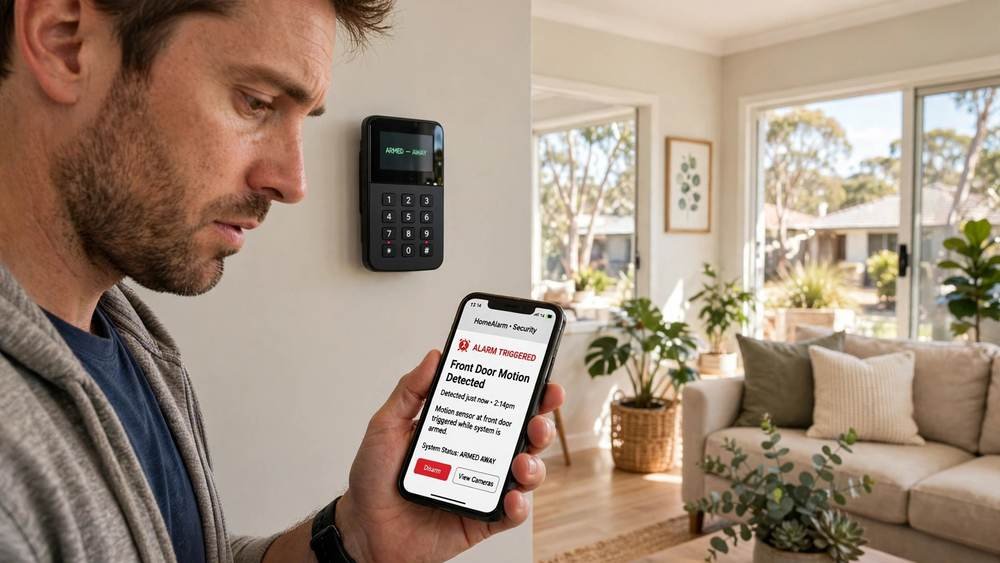
A self-monitored alarm system Australia households run themselves — an alarm that talks to you, and only you. When a sensor trips, your phone buzzes. Nobody else gets the call. There is no control room, no patrol, no monthly fee — and nobody to act while you are asleep, on a plane, or out of mobile range.
That trade is the whole story of this guide. Prices are Australian, checked on 15 November 2026. Our best home alarm system guide compares the panels behind these kits.
What a self-monitored alarm system actually is
Three parts, all yours. First, the sensors: entry sensors on doors and windows, motion sensors in the rooms, a keypad by the door. Second, the hub: the small box that talks to the sensors and to your phone. Third, the app: it arms and disarms the system, names the sensor that tripped, and keeps the event history. When something trips, the siren sounds at the house and the app alerts your phone.
What you do not get is a second pair of eyes. A self-monitored system cannot tell a real break-in from a false alarm, cannot call the police, and cannot send a patrol. Under the national police alarm response guideline, police generally need the alarm verified before attending — by a call, by video or audio where that is set up, or by more than one sensor tripping. That verification is your job when you self-monitor.
Self-monitored alarm system Australia: what you must handle yourself
Self-monitoring is a roster of one. When the alert comes in, you check it: open the app, look at which sensor tripped, check a camera if you have one, and decide what happens next. If it looks real, you call 000. If it looks like the cat, you disarm it and fix the sensor. If you are in a meeting, on a flight, or asleep with the phone on silent, the alert waits.
That is the honest limit. A monitored system hands this job to a control room that answers around the clock; a self-monitored alarm system Australia households run themselves hands it to whoever is holding the phone. Two practical fixes close most of the gap: add a second user to the app — a partner, a housemate, an adult child — so alerts reach two phones, and put a camera where the alarm can be checked from it, so a 2 am alert can be verified in seconds instead of guessed at.
You also own the admin. Batteries, firmware updates, user codes, entry delays, sensor tests: nobody reminds you. A sensor with a flat battery quietly stops reporting, and a system nobody has tested in a year is a box on the wall. Set a monthly reminder — the first of the month, the way you check smoke alarm batteries — and test every sensor with the siren and the app alert at the same time.
What it costs: the kit, the add-ons, and the zero monthly fee
The headline cost is the kit, and there is no monthly fee for self-monitoring itself — the app alerts are free. The kit most Australians actually buy is the eufy 5-in-1: HomeBase, keypad, motion sensor and two entry sensors for $349.95. It is the right kit at the right price, and it is sold out: eufy Australia lists it at $349.95 with no stock. An import listing through Ubuy shows about $329, but that is a US unit needing a step-down transformer — grey-import warranty and a power adapter, not an Australian buy.
The in-stock alternative is the Orion Smart Alarm System Kit with Keypad at $215 from Bunnings: keypad hub, siren and camera unit, two motion sensors, two contact sensors and two RFID tags, on Wi-Fi with the Grid Connect app. Its add-ons are cheap: an Orion motion sensor is $19.98 and a contact sensor is $12.98 at Bunnings. A three-bedroom house usually needs two or three extra contact sensors, so budget about $240 to $255 all-in for the Orion route.
The third path is building from eufy add-ons: a HomeBase 3 at $377, an entry sensor at $48 and a motion sensor at $48, all in stock at Bunnings. That route runs past $470 for a basic set, but it buys into the bigger eufy system of cameras, doorbells and HomeBase storage. For a house that will grow cameras later, it is the better buy; for a house that only needs an alarm, Orion is.
Compare that with the monitored route and the saving is the subscription, not the hardware: standard back-to-base monitoring runs about $25 to $60 a month in Australia, which is $300 to $720 a year before setup and call-outs. Over three years, self-monitoring saves roughly $900 to $2,160 against a monitored plan — real money, and the exact amount depends on the plan you would otherwise buy. Our alarm monitoring cost guide breaks the monitored side down in full.
Which kits self-monitor well in Australia
A good self-monitoring kit does four things: it tells you which sensor tripped by name, it works without a subscription, it keeps a history you can read, and it lets you add a second user. The eufy system does all four through the eufy app and HomeBase, with local storage and no monthly fee. The Orion kit does the same through the Grid Connect app, with 24-hour notifications and remote access. Both are sold in Australia, with Australian warranty and Australian power — which matters more than it sounds, because the kits that are not officially sold here, Ring Alarm and SimpliSafe, come in as grey imports with US power and no local support.
Ajax is the step up for households that want self-monitoring with a professional-grade radio: the Hub 2 Plus runs Ethernet, Wi-Fi and dual-SIM 4G in one panel, with a backup battery rated for about 16 hours, and the app tells you within seconds if communication is lost. It costs more than a Bunnings kit and is usually sold through installers, but it is the self-monitored system that behaves most like a monitored one when the internet drops.
Whatever kit you pick, check three things before you buy: that the app supports more than one user, that the hub has a backup battery, and that the sensors talk to the hub on their own radio — not on your home Wi-Fi — so a dead router does not silence the alarm itself. The alerts still need the internet to reach your phone, which is the one link no self-monitored kit can remove.
When self-monitoring is not enough
Four situations beat self-monitoring. The first is absence: if the house is empty for weeks at a time, or the household travels overseas, nobody is holding the phone when it matters. The second is a monitored-alarm requirement — a commercial lease, a strata rule, or an insurer demanding a graded system — which needs a professional install and its certificate, not an app.
The third is vulnerability: an elderly parent living alone, or a household where nobody is comfortable with the app, should not rely on a system that only works through a phone. The fourth is a house with no reliable internet: self-monitoring alerts need the internet to reach you, and a home with patchy NBN needs a cellular path — a 4G communicator or a hub with a SIM — before the alerts can be trusted at all.
If any of those four applies, the fix is not a better self-monitored kit. It is monitoring: a control room that answers when you cannot. Our monitored alarm system guide covers who actually needs 24/7 response and what it costs.
Self-monitored alarm system Australia: the setup that works
Start with the sensor plan, not the shopping. Walk the house and mark every ground-floor opening — front door, back door, laundry door, garage-to-house door, every reachable window — then the rooms a burglar would cross to reach the valuables. A three-bedroom house usually needs six to eight entry sensors and two motion sensors. Count before you buy, or you will be back at Bunnings mid-install.
Mount the hub near the router, not inside a metal cabinet or behind the TV: the signal to the sensors is short-range and walls eat it. Pair one sensor at a time, in the room where it will live, and test each one as you go. Mount entry sensors on the frame, not the moving part, with the magnet no more than a finger’s width from the sensor body when closed. Motion sensors go in a corner at head height, facing across the room, not at a window or a heater.
Then set the human side up properly. Give every regular user their own code. Add a second app user. Set a 30-second entry delay on the front door and a 45 to 60-second exit delay. Arm it, leave, come back, and trip it on purpose — a system you have never heard go off is a system you have never tested. And write down what each sensor guards: when you hand the system to a housesitter, that list is the difference between a working alarm and a box of blinking plastic.
The false-alarm problem, and how to beat it
Most self-monitored systems fail the same way: not by missing a break-in, but by crying wolf until the household stops arming them. In the first week, arm the system in stay mode and watch what trips it: the cat, the heater, a curtain in the sun, a loose sensor on a rattling door. Each trip has a fix — move the sensor, tighten the gap, turn pet-immunity on, or drop the sensitivity a notch.
False alarms cost more than annoyance when monitoring is involved: patrol attendances run about $70 to $150 per activation. For a self-monitored household the cost is attention — every false alert trains the household to ignore the next one, and the next one might be real. Test every sensor once a month, check battery levels in the app on the first of the month, and replace a sensor that keeps tripping after you have fixed its placement. A sensor that cries wolf is worse than no sensor.
Adding monitoring later: the upgrade path
Self-monitoring does not have to be forever. Most panels that self-monitor can add back-to-base monitoring later, usually by adding a communicator — an IP or 4G module that reports to a control room. CTC Communications lists communicator services at about $38 to $59 plus GST a month, and residential monitoring from $36 a month for 24/7 back-to-base. The panel usually needs to meet the Australian and New Zealand alarm standard AS/NZS 2201.2 before a provider will connect it, so an old or non-compliant panel may need repair first.
Before you sign, read the quote the way you would read a phone plan: the monthly fee, the setup and communicator cost, the contract length, and what each patrol attendance costs. The monthly figure is the smallest part of a three-year total — setup of $500 to $1,200 plus three years of monitoring is the number to compare.
Frequently asked questions
What is a self-monitored alarm system in Australia?
A self-monitored alarm system Australia households run themselves is a wireless alarm — hub, entry sensors, motion sensors and a keypad — that alerts your phone when a sensor trips, with no control room and no monthly fee. You check every alert, decide what it means, and call 000 yourself if it looks real.
Does a self-monitored alarm call the police?
No. A self-monitored system alerts you, and only you. Police generally need the alarm verified before attending, so you — or a second app user, or a camera you can check — do the verifying, and you call 000 if it looks like a break-in. If you want someone else to do that job around the clock, that is back-to-base monitoring.
How much does a self-monitored alarm system cost in Australia?
A complete kit starts at $215 for the Orion kit with keypad at Bunnings, and the eufy 5-in-1 kit is $349.95 when it is in stock. Most houses need two or three extra sensors, so budget $240 to $350 all-in for a three-bedroom house, with no monthly fee for the alerts themselves.
Can I add monitoring to a self-monitored alarm later?
Yes, in most cases. A communicator module — IP or 4G — connects a compatible panel to a monitoring centre, with residential monitoring from about $36 a month at CTC Communications. The panel usually needs to meet AS/NZS 2201.2 first, and setup of $500 to $1,200 is often a separate line item.
Is self-monitoring enough for home insurance?
It depends on the insurer and the policy. Some insurers reward any working alarm; others only recognise professionally installed and monitored systems, and may ask for installation documentation. Check the product disclosure statement and ask your insurer before you buy — a self-monitored kit is not automatically an insurance-approved system.
Prices checked 15 November 2026 from eufy Australia, Bunnings Australia, CTC Communications and Australian monitoring guides. Planning figures, not quotes. External price source: eufy Australia 5-in-1 Alarm Kit.