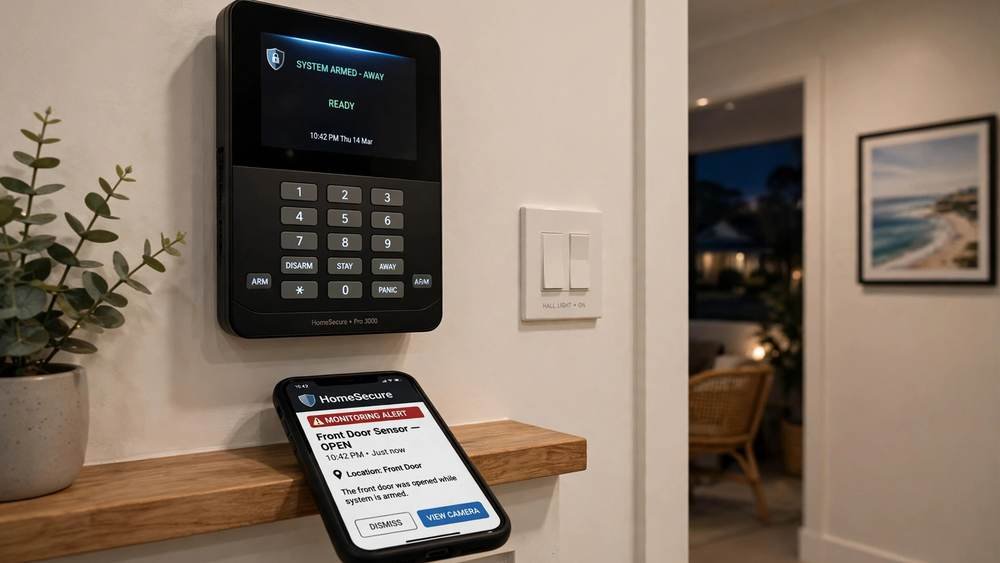
A monitored alarm system Australia household buys is not a louder siren. It is an ordinary alarm — panel, sensors, siren — connected to a staffed monitoring centre that answers when the alarm trips. The siren is what your neighbours hear. The monitoring is what does something about it at 3 am while you are asleep, at work, or on a plane.
That distinction is the whole decision. A self-monitored alarm sends an alert to your phone and leaves the rest to you. A monitored one sends the signal to a control room, where an operator follows the response plan you agreed at sign-up: call the house, call your keyholders, send a patrol if you asked for one, and call the police once the alarm is verified. This guide explains how that chain works, who it suits, and who can skip it — with Australian prices checked on 10 November 2026.
What a monitored alarm system actually is
Three parts make a system “monitored” rather than just loud. First, the alarm itself: panel, door and window contacts, motion sensors, siren. Our best home alarm system guide compares the panels; this article starts where that one ends.
Second, the communicator: the device that carries the signal from your panel to the centre. Modern systems report over the internet, the mobile network, or both — a dual path. A single internet-only path is the weak link: if the modem is down, the signal never leaves the house.
Third, the monitoring centre, usually called an Alarm Receiving Centre. It is staffed around the clock by operators who receive the signal, open your account, and work through your response instructions. In Australia the centre’s grading matters: ASIAL A1 is the top grade — ask for it by name. The Australian Standard AS 2201.2:2022 sets out what back-to-base monitoring covers. One correction: the centre does not watch your house. It receives alarm signals — which sensor tripped, in which zone, at what time — and acts on them.
How the signal travels, step by step
It starts with a sensor: a door contact opens, a motion detector sees movement, a glass-break sensor hears shattering glass, or someone presses a panic button. The panel identifies which zone triggered and what kind of signal it is — intrusion, fire, duress, or a fault such as a flat battery — then sends it through the communicator to the centre. On a dual-path system the signal goes by internet and mobile at once, so one failed path does not stop it. The centre records the time, your address, the zone and the event type, and puts your account in front of an operator within seconds.
The operator opens your file — the response instructions you set at sign-up — and follows them in order: who is called first, what happens if nobody answers, whether a patrol is sent, and what counts as verified enough to call the police. Monitored systems also report in when nothing is happening: a daily check-in tells the centre the system is alive, and a stopped signal or low battery shows up as a fault.
What the operator does when your alarm trips
The operator’s first job is not to send help — it is to work out whether help is needed. Most activations are not break-ins: a cleaner who forgot the code, a sensor knocked by a tradie, a pet in the wrong room. A good operator checks before escalating: every false dispatch costs money and credibility.
The usual sequence runs like this. The operator calls the premises first, so someone at home can cancel with the safe word or code. Then your keyholders are called in the order you set — usually you, then a partner or family member, then a neighbour or friend who can attend. If the alarm is verified — by a call, by video or audio, or by more than one sensor tripping — the operator escalates to a patrol or the police. Under the national police alarm response guideline, police generally need the alarm verified before attending, so you are not paying for a guaranteed police visit — you are paying for someone awake, with your instructions in front of them, deciding at 3 am while you are asleep or away.
Monitored versus self-monitored: the honest comparison
Self-monitoring costs $0 a month to a monitoring centre, because there is no centre: your panel sends alerts to your phone through the manufacturer’s app, and you decide what to do. DIY kits such as eufy’s work this way — our wireless alarm system guide covers those kits.
The difference is not the monthly fee. It is what happens in the hours you cannot act. With self-monitoring, nobody calls your keyholders if you are asleep, on a plane, or out of coverage, and nobody calls the police for you. If your phone is on silent, the alert waits. With a monitored alarm system Australia households pay for, the operator is the backup for every hour you are not watching.
Self-monitoring has real strengths: no contract, no monthly bill, no stranger holding your keyholder list. The app gives you the same arm, disarm and alert functions, and for a household where someone is almost always home, that can be enough. Adding a second trusted contact to the app closes the single-phone gap for free. The honest test is one question: if the alarm trips at 2 am while you are interstate, who acts? If the answer is “nobody, until I see the notification in the morning,” self-monitoring has a hole in it.
Who actually needs a monitored alarm system Australia wide
The deciding factor is household type — not the size of the house, and not the price of the panel.
Frequent travellers and holiday homes. This is the clearest case: a house empty for weeks has nobody to hear the siren or receive the alert in time.
Shift workers and FIFO households. Night shift, rotating rosters, and FIFO swings create the same gap: the house is occupied, but the person who would act is asleep after a night shift or on a plane with the phone off.
People living alone, including older Australians. A monitored system adds two things a lone occupant cannot give themselves: a second pair of hands on the response, and a panic button that reaches a real person.
Families with kids, pets, or regular visitors. Children coming home alone, a dog tripping a motion sensor, cleaners and tradies with temporary codes — all need a calm, correct response. Pet-friendly detectors cut the false alarms.
High-value homes and contents. A house with significant contents benefits from the verified response and the insurance recognition monitoring brings. Some Australian insurers may offer reduced premiums for monitored alarms — but requirements vary, so check your policy wording first.
Strata and commercial requirements. Some body corporate rules and commercial leases require a monitored alarm as a condition of occupancy or insurance — then the choice is made for you.
Who can probably skip monitoring
Monitoring is not for everyone. Owner-occupiers who work from home, or are rarely away for long, get most of what they need from self-monitoring: full visibility, no ongoing fee, and a person on site to act. If you are home most evenings, the operator is duplicating a job you already do.
Renters are the second group. A portable wireless system with self-monitoring fits a rental: no drilling, no contract tied to the property, and the kit moves with you. A monitored system usually means a fixed panel and a contract the landlord may not want. Check the lease first.
Tech-confident households are the third. If you are comfortable managing notifications and coordinating a response yourself — and there are two of you doing it, so one phone on silent is not a single point of failure — self-monitoring is a capable, cost-effective choice. The line is about availability, not budget: can someone reliable act on an alert at any hour? If the answer is honestly yes, self-monitoring is enough. If it is no, that gap is exactly what monitoring is for.
What a monitored alarm system costs
Monitoring is a subscription, so judge it by the annual total, not the monthly headline. The full cost picture is covered in detail in our alarm monitoring cost guide.
Standard back-to-base monitoring in Australia usually runs $25 to $60 a month, or about $300 to $720 a year, before setup and call-outs. Starting prices checked on 10 November 2026 include NRMA Security wireless monitoring from $35 a month and CTC Communications 24/7 monitoring at $38 a month. CTC also lists patrol dispatch at $65 to $85 including GST.
Setup is the part people forget: a typical configuration allowance runs $500 to $1,200 for the communicator, fitting and programming, and a communicator service can run $38 to $59 plus GST a month. Hardware varies too: CTC lists a Bosch Solution 2000 fully installed at $1,020, and a Bosch Solution 6000 with a back-to-base monitoring deal at $1,966.13 — both live on 10 November 2026, before any monthly fee. One trap: the cheapest monthly fee is not the cheapest plan — a $35 plan charging separately for the communicator and every patrol visit can cost more over a year than a $40 plan that includes them.
Before you sign: eight checks
Get every quote in writing, on the same basis, and check these eight things before you sign anything:
- Centre grading: is it graded to Australian Standards, and which grade? ASIAL A1 is the top grade — ask for it by name.
- Signal path: single or dual (internet plus mobile)? Dual costs more and fails less.
- Communicator age: is it 4G or newer? Australia’s carriers have retired 3G, so an older 3G communicator may no longer deliver signals.
- Escalation order: who is called first, what happens if nobody answers, and does the plan include patrol or only phone calls?
- Verification: how does the centre decide an alarm is genuine before calling the police — a call, video, audio, or more than one sensor?
- Contract and exit: month to month, or a 12- or 24-month term? What does it cost to leave, and who owns the communicator?
- Fault reporting: does the system report in daily, so a dead communicator or flat battery shows up as a fault?
- Insurance proof: ask your insurer what proof they want — some ask for the monitoring certificate, not just the panel receipt.
One last check costs nothing: ring the monitoring centre at 2 am before you sign, just to confirm it answers.
Frequently asked questions
What is a monitored alarm system in Australia?
A monitored alarm system Australia households buy is an alarm panel connected to a staffed monitoring centre, usually called an Alarm Receiving Centre. When a sensor trips, the panel sends a signal to the centre, and a trained operator follows your agreed response plan — calling you and your keyholders, and escalating to a patrol or the police once the alarm is verified.
How much does a monitored alarm system cost in Australia?
Standard back-to-base monitoring usually runs $25 to $60 a month, or about $300 to $720 a year, before setup and call-out charges. Advertised starting prices checked on 10 November 2026 include NRMA Security wireless monitoring from $35 a month and CTC Communications 24/7 monitoring at $38 a month. Setup typically adds $500 to $1,200 for the communicator and fitting.
Do I need a monitored alarm system, or is self-monitoring enough?
It depends on who can act when an alarm trips. Self-monitoring is enough if someone reliable can receive, assess and act on alerts at any hour. A monitored alarm system Australia wide is worth it for frequent travellers, holiday homes, shift and FIFO workers, people living alone, and high-value properties — anywhere an alert might go unanswered.
Does a monitored alarm guarantee the police will come?
No. The monitoring centre calls you and your keyholders first, and police are generally only called once the alarm is verified — by a call, video, audio or more than one sensor tripping. An unverified single-sensor alarm will usually get a phone call, not a police car.
Can renters get a monitored alarm system?
Usually a portable wireless system with self-monitoring suits renters better: no drilling, no contract tied to the property, and the kit moves with you. A monitored system generally means a fixed panel and a contract, so check the lease before anything is fixed to the walls.
What happens if my internet goes down?
It depends on the signal path. A system that reports only over the internet cannot send anything while the modem is down. A dual-path system reports over the internet and the mobile network, so it keeps talking to the monitoring centre when the NBN drops. Ask for dual-path before you sign.
Prices checked 10 November 2026 from Australian listings: NRMA Security, CTC Communications, GM Group Services, Alltronic, Pacific Security Group, and ADT Security. Planning figures, not quotes for a particular property. External price source: GM Group Services back-to-base monitoring guide.