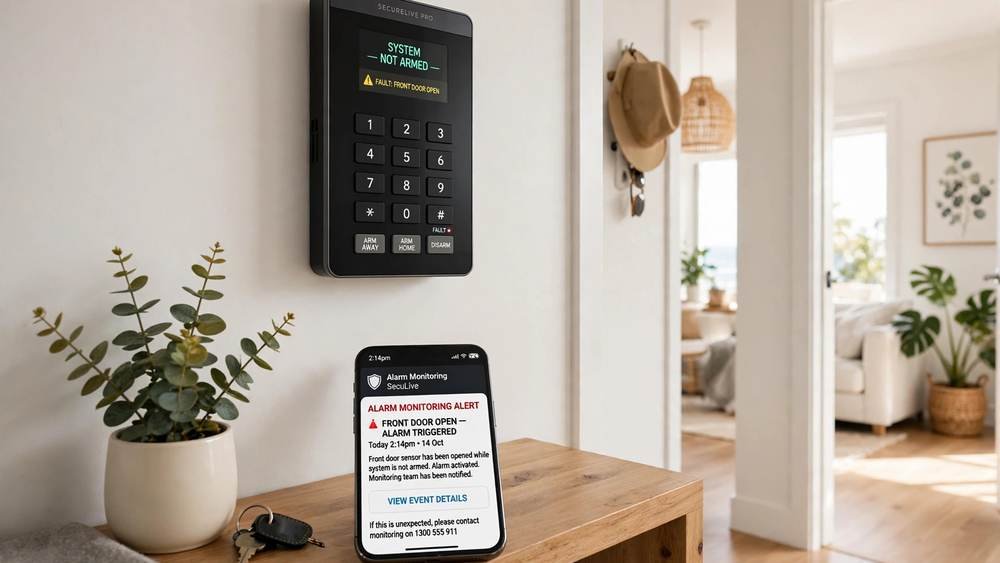
An alarm monitoring cost Australia quote is rarely one number. The monthly fee is the advertised part, but the real cost adds setup, the communicator that carries the signal, and whatever you pay when someone has to attend. This guide puts those pieces together with real Australian provider prices, so you can see the full bill first.
Every price below comes from Australian provider and installer listings checked on 8 November 2026 — planning figures from published ranges and advertised starting prices, not a quote for your house. Your price depends on your panel, signal path and inclusions, and where a figure comes from a guide rather than the provider itself, the article says so.
What alarm monitoring actually does
Back-to-base monitoring connects your alarm panel to a staffed monitoring centre, usually called an Alarm Receiving Centre. When a sensor trips, the panel sends a signal over a phone line, the internet or a mobile network, and an operator follows the instructions you agreed when you signed up.
That is the part people misunderstand most: monitoring does not mean the police are sent automatically. The centre normally calls the premises first, then your keyholders, and only escalates to a patrol or the police once the alarm has been checked — by a call, by video or audio where that is set up, or by more than one sensor tripping. Under the national police alarm response guideline, police generally need the alarm verified before attending, and repeated false alarms can trigger a response policy. So you are not paying for a guaranteed police visit — you are paying for someone awake and deciding at 3 am while you are asleep or away.
The centre itself matters too: look for one graded to Australian Standards — ASIAL A1 is the top grade. The monthly fee buys only the centre’s side — receiving signals and escalating them — while hardware, installation and attendance sit outside it.
Alarm monitoring cost Australia: the monthly fee
For a standard home, alarm monitoring cost Australia usually sits between $25 and $60 a month. Castle Security’s guide puts standard monitoring at $30 to $60 a month, or $360 to $720 a year, and other Australian guides land in the same place. Anything well below that range usually leaves something out — the communicator, the response, or both.
Here is how the tiers stack up, with advertised starting prices live on 8 November 2026:
- Basic internet-connected monitoring, $25 to $40 a month. The panel reports over your internet connection — cheapest to run, but useless if the internet drops with no mobile backup.
- Standard back-to-base monitoring, $30 to $60 a month. The centre receives signals and escalates them by phone to you and your keyholders. CTC Communications lists residential monitoring from $29.99 a month, NRMA Security wireless back-to-base from $35, and Z Protection Services monitoring from $40.
- Response-inclusive plans, $80 to $130 a month. These add a patrol or guard response, so someone is sent to the property rather than just phoned — ADT Guard, which adds live video monitoring, starts from $80 a month.
- Commercial monitoring, $40 to $120 a month — shops and offices pay more for more zones, more keyholders and usually dual signal paths. CTC lists commercial monitoring from $49.99 a month.
Some providers price by the week: DynData, a Queensland provider, publishes telephone-line monitoring at $6.95 a week, IP at $7.95 and GPRS mobile at $11.95, all including GST — about $361, $413 and $621 a year. Weekly pricing looks small, so multiply it out to the year before comparing it with a monthly quote.
One more monthly charge to check: CTC’s published communicator services run about $38 to $59 plus GST a month. The cheapest advertised alarm monitoring cost Australia figure is not automatically the cheapest plan: a $29.99 plan that charges separately for the communicator can cost more over a year than a $40 plan that includes it. Compare the annual total, not the headline month.
One-off costs before monitoring starts
Monitoring needs a way to talk to the centre — a one-off cost on most existing panels. Australian guides put a typical setup at roughly $500 to $1,200 for the communicator and the fitting and programming: a configuration allowance, not a quote. A simple IP communicator on a modern panel costs less than a dual-path mobile unit on a ten-year-old one.
Two examples show how the one-off costs land: Metwide, a Sydney provider, advertised residential monitoring at $39.95 a month including GST plus a $300 activation fee — the first year $779.40, each year after $479.40 before extras. DynData lists $450 to fit a GPRS unit. Switching is not always expensive: Z Protection lists $0 to switch your monitoring — worth knowing if you already have a panel and only the contract is the problem.
Before you pay for any communicator, ask whether it still uses 3G: Australia’s carriers have retired 3G, so an older 3G communicator may no longer deliver signals to the centre at all. A cheap second-hand panel with a 3G communicator is no saving if the signal never arrives — a 4G communicator with a fallback path, internet plus mobile, is the combination worth paying for.
Buying a whole system rather than adding monitoring to a panel you own? Castle Security’s guide uses about $2,100 upfront with $40 a month monitoring, and puts a full alarm system at roughly $1,200 to $3,000 installed. Our best home alarm system guide covers the panels themselves; this article stays on what monitoring adds to the bill.
Call-out, patrol and false-alarm charges
This is the line that turns a $40-a-month plan into a $400 month: when the centre sends someone to your property — a patrol guard, a technician, or the fire brigade — that attendance is usually billed separately, unless your plan says otherwise.
Z Protection lists alarm response from $50 per attendance, with two free false-alarm attendances a month on eligible systems they installed and monitor — the detail to look for. It covers the occasional sensor knocked by a tradie, while a plan with no free attendances bills you from the first one.
False alarms cost far more when they involve the fire service. These charges are for fire alarms, not burglar alarms, but they show the scale: Western Australia’s fire service lists $1,337 per false fire-alarm attendance for 2025–26, and Fire Rescue Victoria lists $675 per truck per 15 minutes for 2026–27. Those are government charges, not provider fees — but the lesson carries over: a sensor that false-alarms monthly is a recurring bill, and after enough of them the centre or police may treat your next alarm with less urgency.
The fix is unglamorous: keep sensors clean, replace flat batteries before they cause trouble, tell the centre when tradies or a house sitter are coming, and put the system on test before work that might trip it. Most false alarms are preventable — preventing them is cheaper than paying for them.
Self-monitoring versus back-to-base: the real cost gap
Self-monitoring costs $0 a month to a monitoring centre, because there is no centre: your panel sends alerts to your phone through the manufacturer’s app, and you decide what to do. DIY kits such as eufy’s work this way — our wireless alarm system guide covers those kits.
The gap is not the $30 to $60 a month — it is what happens when you cannot act. With self-monitoring, nobody calls your keyholders if you are asleep, on a plane or out of coverage, and nobody calls the police for you. If your phone is on silent, the alert waits. Back-to-base monitoring exists for the hours you are not watching — most of the day, for most households.
One free improvement: some kits let a family member receive alerts as a second contact, closing the single-phone gap without adding monitoring. One difference hides in the fine print: some monitored plans include an annual service or battery check, while self-monitored kits leave maintenance to you. A flat battery can leave a monitored system reporting a fault, while a self-monitored system just stops protecting you without telling anyone — so factor a yearly battery and sensor check into the self-monitored cost, even though nobody bills you for it.
Five-year cost, worked out
Monthly fees look small until you multiply them: standard monitoring at $30 to $60 a month is $1,800 to $3,600 over five years before a single patrol attendance, activation fee or false-alarm charge — $1,500 to $3,600 at the wider $25 to $60 range. That is the subscription alone, for five years, with nothing going wrong.
Add the one-off costs and the picture changes: the Metwide example — $39.95 a month plus $300 activation — is $779.40 in year one, $479.40 a year after, about $2,697 over five years before call-outs. The Castle example — about $2,100 upfront with $40 a month — is about $4,500 over five years including the system. A response-inclusive plan at $80 to $130 a month is $4,800 to $7,800 over five years before attendance fees — which is why the patrol question matters more than the monthly fee. If the plan includes patrol, that money buys attendance; if not, phone calls only, and every visit is extra.
The cheapest five-year outcome is usually not the cheapest monthly fee, but the plan whose extras match your house: a dual-path communicator if your internet is unreliable, patrol included if you travel often, a false-alarm allowance if your household has kids, pets or tradies. Work out your five-year figure for two or three providers on the same basis — same signal path, response and inclusions — and the comparison becomes honest.
How to compare monitoring quotes
Get every alarm monitoring cost Australia quote in writing, on the same basis, and check these eight things before you sign:
- Signal path: single (internet only) or dual (internet plus mobile)? Dual costs more and fails less.
- Centre grading: is it graded to Australian Standards, and which grade? ASIAL A1 is the top grade.
- Escalation: who is called first, what happens if nobody answers, and does the plan include patrol or only phone calls?
- False alarms: how many free attendances a month, what each extra one costs, and what happens after repeated ones?
- Contract length and exit: month to month, or 12- or 24-month term? What does it cost to leave, and who owns the communicator?
- Communicator: 4G or newer, and is its cost in the quote or on top? Is the price quoted including GST?
- Maintenance: is an annual service or battery check included, or billed separately?
- Insurance: ask your insurer whether a monitored alarm changes your premium and what proof they want — some ask for the monitoring certificate, not just the panel receipt.
One last check costs nothing: ring the monitoring centre at 2 am before you sign, just to confirm it answers. The monthly fee promises someone is there at 2 am — make sure someone is.
Monitoring fees are not camera subscription fees: our security camera subscription costs guide compares those separately, so the two bills are not confused.
Frequently asked questions
How much does alarm monitoring cost in Australia?
Standard back-to-base alarm monitoring cost Australia wide is usually $25 to $60 a month, or $360 to $720 a year, before setup and call-out charges. Advertised starting prices include $29.99 a month from CTC Communications and from $35 a month from NRMA Security.
Is back-to-base monitoring worth it over self-monitoring?
It is worth it if nobody is reliably watching your phone. Self-monitoring costs $0 a month but nobody else acts when you are asleep, away or out of coverage. Back-to-base monitoring pays for an operator who calls you, your keyholders and, when the alarm is verified, a patrol or the police.
What extra charges come with alarm monitoring?
The common extras are setup and the communicator (roughly $500 to $1,200 to configure), an activation fee (Metwide charges $300), patrol attendance (from $50 a visit with some providers), and false-alarm charges. Fire-alarm false attendances can cost far more — $1,337 in Western Australia for 2025–26.
Does alarm monitoring guarantee the police will come?
No. The monitoring centre calls you and your keyholders first, and police are generally only called once the alarm is verified — by a call, video, audio or more than one sensor tripping. An unverified single-sensor alarm will usually get a phone call, not a police car.
Can I switch monitoring providers without replacing my alarm?
Often, yes. If your panel is compatible with the new provider’s communicator, switching can be a reprogramming job rather than a new system, and some providers list $0 to switch monitoring. Check first whether your current contract has an exit fee and who owns the communicator.
Prices checked 8 November 2026 from Australian listings: GM Group Services back-to-base cost guides, Castle Security’s alarm cost guide, NRMA Security, CTC Communications, ADT Security, Z Protection Services, and DynData and Metwide pricing as reported in those guides. Weekly prices are shown as published, annualised at 52 weeks. Planning figures, not quotes for a particular property. External price source: GM Group Services back-to-base monitoring cost guide.