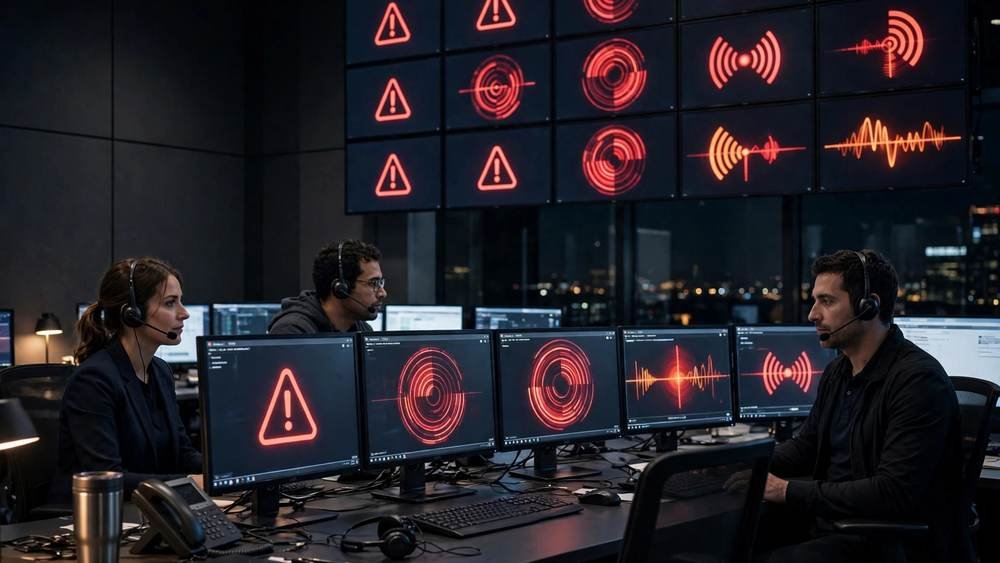
Back-to-base monitoring Australia households buy is not a person watching your house. It is a chain: your alarm panel sends a signal, a communicator carries it, and a staffed monitoring centre — usually called an Alarm Receiving Centre — receives it and follows an agreed procedure. What you are buying is someone awake at 3 am who knows what to do next.
This guide walks the whole chain in order: how the signal travels, what the centre does with it, what the monthly fee actually covers, and what gets billed on top. Prices are Australian, checked on 15 November 2026. Our alarm monitoring cost guide breaks the fees down tier by tier.
Back-to-base monitoring Australia: how the signal travels
It starts at the panel. When a sensor trips, the panel raises an alarm signal and hands it to a communicator — a small module that carries the signal out of the house. Older communicators used the copper phone line. Modern ones use IP over the home internet, or a mobile data path over 4G, or both at once. The dual-path setup — IP plus GPRS — is the one installers recommend, because a single path is a single point of failure.
The signal lands at the monitoring centre, which is staffed around the clock. The centre’s system matches the signal to your account: your address, your keyholders, your instructions. That match is why the centre can act in seconds instead of asking questions first. The whole path, from sensor to operator, is usually measured in seconds — provided the communicator has a path at all. A panel whose only path is the internet goes silent when the modem dies, which is why the communicator choice matters as much as the panel.
One Australian detail decides whether this works at all: the 3G shutdown. Australia’s major carriers have retired their 3G networks, so an older communicator that depends on 3G may no longer deliver signals to the monitoring centre. If you are taking over an old panel, check its communicator before paying for monitoring — a dead path means a subscription to nothing.
What the control room does when your alarm goes off
The centre does not send the police automatically. The normal procedure is a chain: first the centre calls the premises, then your listed keyholders, and only then escalates — to a patrol, or to the police — once the alarm has been checked. Checking can mean a call, video or audio where that is set up, or more than one sensor tripping. Under the national police alarm response guideline, police generally need the alarm verified before attending.
That chain is the product. A self-monitored alarm leaves the whole chain to whoever is holding the phone; back-to-base monitoring Australia providers run it with operators who do it all night, every night. The difference shows up in the cases self-monitoring cannot cover: the household asleep, the household overseas, the phone on silent, the phone with a flat battery.
The centre also watches for silence. Monitored alarms report in daily, so a communication fault or a low battery shows up in the reports and gets booked for repair. An alarm that stops reporting is picked up through polling — the centre notices the absence, not just the alarm. That quiet supervision is part of what the fee buys, and it is the part nobody sees until it catches a fault.
What the monthly fee covers — and what it does not
For a standard home, back-to-base monitoring Australia wide usually sits between $25 and $60 a month. Castle Security’s guide puts standard monitoring at $30 to $60 a month, or $360 to $720 a year. Advertised starting prices live on 15 November 2026 include CTC Communications at $36 a month for 24/7 back-to-base monitoring, NRMA Security wireless back-to-base from $35 a month, and Metwide residential monitoring at $39.95 a month. Plans that include patrol or guard response run roughly $80 to $130 a month.
What that fee covers is signal reception and escalation: the centre receives the signal, follows your procedure, and calls the people on it. What it usually does not cover is everything after the phone call. A patrol attendance is usually billed separately — about $70 to $150 per activation — and some providers list alarm response from $50 per attendance, with two free false-alarm attendances a month on eligible systems they installed and monitor. Fire-brigade attendance is a separate government charge entirely, and it can dwarf the monthly bill: Fire Rescue Victoria lists $675 per truck per 15 minutes for the 2026–27 financial year.
Setup is a separate line too. A monitoring-capable configuration typically runs $500 to $1,200 to set up, and the communicator hardware itself can run about $200 to $800 or more for an IP or cellular unit. CTC lists communicator services at about $38 to $59 plus GST a month, with unsupervised or supervised open and close signalling and single- or dual-SIM options. DynData’s published weekly rates list telephone-line monitoring at $6.95 a week, IP at $7.95 a week and GPRS at $11.95 a week, with GPRS fitting generally costing $450. Five years of standard monitoring costs roughly $1,500 to $3,600 before a single patrol attendance, activation fee or false-alarm charge is added.
The grading that separates a control room from a call centre
Not every monitoring centre is graded the same. ASIAL A1 is the top grade for alarm monitoring in Australia, and it is the grade to ask about. The grading covers the centre itself — its staffing, its power and communications redundancy, its procedures — not just the brand on the door. A provider that installs to the Australian and New Zealand alarm standard AS/NZS 2201.1, and whose monitoring centre holds an ASIAL grading, is making a claim you can check.
Providers generally require the system to meet the standard AS/NZS 2201.2 before they will connect it. A non-compliant old panel may need repair first, and that repair is a separate quote. Ask for the grading in writing before you sign, the same way you would ask for a licence number from an installer. If a provider cannot name its centre’s grade, that is an answer too.
Contracts: the part people sign without reading
Some monitoring plans are month to month. Some run one to three years with early termination fees. Some bundle the equipment into the monthly figure, so the hardware is effectively financed rather than bought — and two apparently similar offers can differ by thousands across the term. Monitoring at $25 to $60 a month over a three-year term adds $900 to $2,160, and a quote that bundles equipment into that figure hides the hardware cost inside the subscription.
Read the quote the way you would read a phone plan, and ask five questions before signing. First, what is the monthly fee, and does it include GST? Second, what is the setup and communicator cost? Third, what does each patrol attendance cost, and how many false-alarm attendances are free? Fourth, what is the contract length, and what does it cost to leave early? Fifth, what happens after repeated false alarms — does the centre change how it treats your next alarm? The answers, not the monthly figure, are the price.
Back-to-base monitoring Australia: who actually needs it
Three households need it most. The first is the household that is often away: frequent travellers, shift workers, families with a holiday house. The second is the household with someone vulnerable at home: an elderly parent living alone, or anyone who could not respond to an alert themselves. The third is the household whose insurer or lease requires it — a monitored-alarm requirement needs a graded system and its certificate, and a self-monitored kit does not satisfy it.
Three households can reasonably skip it. A household where someone is almost always home, with a second app user and a camera to verify alerts, covers most of what monitoring does during the day. A small unit with one entry point and a loud siren may not need a control room at all. And a renter in a short lease may not want a contract that outlasts the tenancy. Our monitored alarm system guide works through the household types in detail.
Setting it up: panel, communicator, and the first test
Setup starts with the panel, not the contract. A wired Bosch panel — the Solution 2000, 3000 or 6000 — is the usual monitored-panel choice in Australia, professionally installed; CTC Communications lists a Bosch Solution 2000 fully installed at $1,020. A wireless Ajax hub reports over 4G as standard, so the connection holds when the home internet drops or the NBN is down, and its backup battery keeps it reporting through a power cut.
Then comes the communicator: IP, GPRS, or both. Dual-path costs more and fails less. Then the procedure: the centre needs your keyholders in the right order, your duress arrangements if any, and your instructions for pets, housesitters and alarm tests. Then the test that matters: trip the alarm on purpose, in stay mode, and watch the chain run — premises call, keyholder call, escalation. A monitoring arrangement you have never seen work is an arrangement you have never tested. Tell the centre before you test, or the test becomes a patrol attendance with a bill attached.
When back-to-base is not the answer
Back-to-base monitoring does not fix a bad alarm. A panel with dead zones, a sensor facing a heater, or a battery past its life will false-alarm just as happily through a control room as it would on your phone — and each attended false alarm can cost $70 to $150. Fix the alarm first, then add the monitoring. A sensor that cries wolf is worse than no sensor, and a monitoring centre cannot tell a real break-in from a curtain in the sun.
It also does not replace the physical basics. A monitored alarm on a house with a flimsy back door and no sensor on it is a subscription to a gap. Doors, windows, lighting and locks come first; monitoring is the layer on top, not the foundation. And it does not make the house safe while the internet and the power are both down unless the communicator has its own path and the panel has its own battery — check both before you rely on either.
Frequently asked questions
What is back-to-base monitoring in Australia?
Back-to-base monitoring Australia providers run a staffed monitoring centre — an Alarm Receiving Centre — that receives signals from your alarm panel over IP or 4G and follows an agreed procedure: calling the premises, then your keyholders, then escalating to a patrol or the police once the alarm is verified.
How much does back-to-base monitoring cost in Australia?
Standard monitoring usually runs $25 to $60 a month, or $300 to $720 a year, before setup and call-outs. Advertised starting prices include CTC Communications at $36 a month, NRMA Security from $35 a month, and Metwide at $39.95 a month. Setup typically runs $500 to $1,200, and patrol attendances are usually billed separately at about $70 to $150 each.
Does back-to-base monitoring call the police automatically?
No. The centre normally calls the premises first, then your keyholders, and only escalates to a patrol or the police once the alarm has been checked. Police generally need the alarm verified before attending, so the centre’s verification step — a call, video or audio, or more than one sensor tripping — is part of the service.
What happens if my internet goes down?
It depends on your communicator. An IP-only path goes silent when the modem dies. A 4G or dual-path communicator keeps reporting through an NBN outage, which is why installers recommend dual-path. Older 3G communicators no longer work at all in Australia, so check the communicator before paying for monitoring.
Can I get back-to-base monitoring on my existing alarm?
Often, yes — a communicator module can connect a compatible panel to a monitoring centre. The panel usually needs to meet AS/NZS 2201.2 first, and a non-compliant old panel may need repair. DynData lists existing-panel takeover at $300 one-off plus $39.95 a month as one published example; your installer will quote for your panel.
Prices checked 15 November 2026 from GM Group Services, Castle Security, CTC Communications, NRMA Security, Metwide, DynData and Z Protection Services as reported in Australian monitoring guides. Planning figures, not quotes. External price source: GM Group Services back-to-base monitoring cost guide.