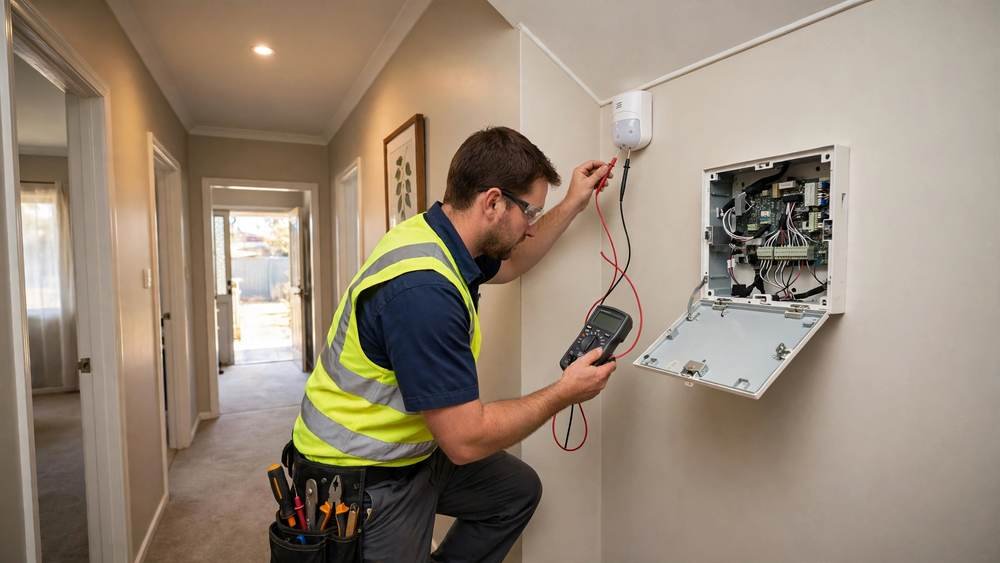
Alarm system maintenance Australia households actually do is not a service contract. It is a routine: a monthly check you do yourself in ten minutes, an annual service by a professional, and parts replaced before they fail instead of after. An alarm that nobody maintains is a box on the wall, and the first you hear about it is usually the night it does not work.
This guide covers the routine in order: what to check every month for free, what the annual service includes, what wears out and when, and what it costs. Prices are Australian, checked on 15 November 2026. Our best home alarm system guide compares the panels this routine keeps alive.
What alarm system maintenance actually covers
Four things, and they fail in order. First, the power: the panel battery and the sensor batteries. Second, the detectors: dust, spiders and sun can all blind a motion sensor, and a loose entry sensor stops reporting reliably. Third, the communication: the path to your phone or to the monitoring centre — IP, 4G, or both. Fourth, the programming: user codes that should have been removed, entry delays that no longer suit the household, a housesitter’s code still active months later.
Maintenance is the habit of checking those four before they fail. A monitored alarm helps: monitored alarms report in daily, so a communication fault or a low battery shows up in the reports and gets booked for repair. A self-monitored alarm has no such safety net — if you do not check it, nobody does. Our monitored alarm system guide covers who actually needs 24/7 response; the maintenance routine below applies to both.
Alarm system maintenance Australia: the monthly check (free, ten minutes)
This monthly check is the core of alarm system maintenance Australia households can do themselves — do it on the first of the month, the way you check smoke alarm batteries. First, open the app and check battery levels: every sensor should report a healthy battery, and the panel should show no low-battery warning. Second, walk-test every sensor: arm the system in stay mode, trip each sensor on purpose, and confirm the app names the right sensor each time. A sensor that does not report is a sensor to fix, not to trust.
Third, test the siren: arm the system, trip it, and listen. A siren you have never heard go off is a siren you have never tested. Fourth, check the entry delays: arm it, leave, come back, and confirm the 30-second entry delay on the front door still gives you time to disarm it. Fifth, look at the detectors: wipe dust off motion sensors, check entry sensors are still tight on their frames with the magnet no more than a finger’s width away, and move any sensor that now faces a heater, a sunlit window, or a curtain that moves in a draught.
Then check the admin. Remove codes for people who no longer need them — the housesitter, the tradie, the ex-housemate. Check the firmware is up to date: the hub updates through the app, and a hub that updates mid-install drops every sensor you have just paired, so update it deliberately, not by accident. Write down anything that failed the test, and fix it the same week. A written list of what each sensor guards is the difference between a working alarm and a box of blinking plastic when you sell the house or hand the system to a housesitter.
The annual professional service: what it includes
Once a year, a professional should look at the system properly. A service visit typically covers a full system test — every sensor, the siren, the strobe, the keypad and the panel — a battery health check with a meter rather than a guess, a clean of the detectors, a check of the communication path, and a firmware and programming review. The technician should also check the panel against the Australian and New Zealand alarm standard AS/NZS 2201, and flag anything that would stop a monitoring provider connecting it.
There is no published national fixed price for a security-alarm service visit — most installers quote per visit, and the honest answer is to get the visit itemised before booking. As a benchmark for what annual testing costs, residential fire-alarm testing and inspection guides put annual testing at $200 to $500 for residential properties. That figure is for fire systems, not security alarms, but it shows the shape of an annual testing visit: a few hundred dollars, not a few thousand. For smoke alarms specifically, one Australian provider lists a yearly attendance rate of $99 plus GST, and another lists a once-off inspection at $149 — again smoke alarms, not security panels, but the same annual-visit shape.
What to ask before booking: does the visit include a battery, or is the battery extra? Does it include a written report? Will the technician test the monitoring path, or only the local alarm? And will they check the panel battery under load — a battery that reads fine at rest and collapses under load is the one that fails in a blackout.
Alarm system maintenance Australia: what wears out, and when
The panel battery wears out first. A 12-volt sealed lead-acid battery lasts three to five years, sometimes sooner in hot conditions, and a battery past its best might only hold a charge for 30 minutes rather than a full day — which you will not discover until the first proper blackout. A replacement 12-volt 7Ah battery costs $25.99 from CTC Communications, suits Bosch, Hills Reliance and DSC panels, and a Bosch-branded 12-volt 7Ah battery is $28 from CCTV Importers. Replace it on a schedule, not on a failure: write the install date on the battery, and replace it at year four whether it complains or not.
Sensor batteries wear out next. Wireless sensors run on batteries that last a year or two, and the app reports their levels — replace them when the app says low, not when the sensor goes silent. A sensor with a flat battery quietly stops reporting, and a system that misses one monthly test is a system to fix, not to trust.
Detectors wear out slowest, but they do wear out. Motion sensors gather dust and spider webs, entry sensors loosen on their frames, and outdoor detectors face sun, rain and insects year-round. A detector that false-alarms after you have fixed its placement — moved it away from heat and sun, tightened the gap, checked the battery — is a detector to replace. A sensor that cries wolf is worse than no sensor.
The false-alarm connection: maintenance is prevention
Most false alarms are maintenance failures wearing a different name. A pet in a motion sensor zone, a loose entry sensor with too wide a magnet gap, a sensor facing a heater or a sunlit window, a flat sensor battery: each one is a monthly check that did not happen. In the first week after install, arm the system in stay mode and watch what trips it, and fix each trip the same way — move the sensor, tighten the gap, turn pet-immunity on, or drop the sensitivity a notch.
False alarms cost more than annoyance. Patrol attendances run about $70 to $150 per activation, and repeated false alarms can change how a monitoring centre or the police treat your next alarm. For a self-monitored household the cost is attention: every false alert trains the household to ignore the next one, and the next one might be real. Maintenance is the cheapest false-alarm prevention there is, because it costs ten minutes a month.
Monitored systems: what the centre catches for you
A monitored alarm does part of the maintenance for you. The panel reports in daily, so a communication fault, a low battery or a sensor that stops reporting shows up in the centre’s reports and gets booked for repair. The centre also notices silence: an alarm that stops reporting is picked up through polling, so the fault is found even if nobody at the house noticed.
That does not remove the monthly check. The centre cannot see dust on a motion sensor, a loose entry sensor, or a code that should have been removed. It catches the electronic faults; the physical ones are still yours. And if the system is monitored, tell the centre before you test — a test that the centre does not know about becomes a patrol attendance with a bill attached.
Keeping records: the file that saves you twice
Keep a file for the alarm: the install date, the panel model, the battery install date, the monitoring details if any, and the written list of what each sensor guards. The file saves you twice. First, when something fails: the battery date tells you whether the battery is due, and the sensor list tells the technician what to check. Second, when you sell the house or hand the system to a housesitter: the file is the difference between a working alarm and a box of blinking plastic.
It also saves you with the insurer. Some insurers ask for installation documentation, and a file with the install date, the panel model and the service history is the documentation. A system with no records is a system whose history has to be guessed at, and guesses cost money at claim time.
Start the file on the day the system goes in, not the day something fails. Photograph the panel label, the battery with its date written on it, and the sensor list on the wall beside the panel. Note the monitoring details if any, the installer’s name and licence number, and the date of each annual service. Alarm system maintenance Australia households do properly is mostly this file plus ten minutes a month: the file remembers what the household forgets, and the monthly check catches what the file cannot see.
Frequently asked questions
How often should a home alarm system be serviced in Australia?
Check it yourself every month — walk-test every sensor, test the siren, check battery levels in the app — and have a professional service it once a year. The annual service covers a full system test, a battery health check under load, a clean of the detectors, and a check of the communication path.
How much does alarm system maintenance cost in Australia?
The monthly check is free. The parts are cheap: a 12-volt 7Ah panel battery costs $25.99 from CTC Communications, and a Bosch-branded one is $28. That is the whole of alarm system maintenance Australia households pay for in most years: a $25.99 battery and ten minutes a month. A professional service visit is quoted per visit — there is no published national fixed price — and annual testing guides put residential testing visits at $200 to $500 as a benchmark.
How long does an alarm panel battery last?
Three to five years for a 12-volt sealed lead-acid battery, sometimes sooner in hot conditions. Replace it on a schedule — write the install date on the battery and replace it at year four — because a battery past its best might only hold a charge for 30 minutes in a blackout.
What maintenance does a monitored alarm need?
The same monthly check as a self-monitored alarm, plus the annual professional service. The monitoring centre catches electronic faults — low batteries, communication failures, silent sensors — through daily reporting, but it cannot see dust, loose sensors or stale user codes. Tell the centre before you test, or the test becomes a patrol attendance.
Why does my alarm keep false alarming?
The usual causes are a pet in a motion sensor zone, a loose entry sensor with too wide a magnet gap, a sensor facing a heater or a sunlit window, or a flat sensor battery. Check the magnet gap first, move the sensor away from heat and sun, and check the battery level in the app. If one sensor keeps tripping after that, replace it.
Prices checked 15 November 2026 from CTC Communications, CCTV Importers and Australian servicing guides. Planning figures, not quotes. External price source: CTC Communications 12V 7Ah alarm battery.