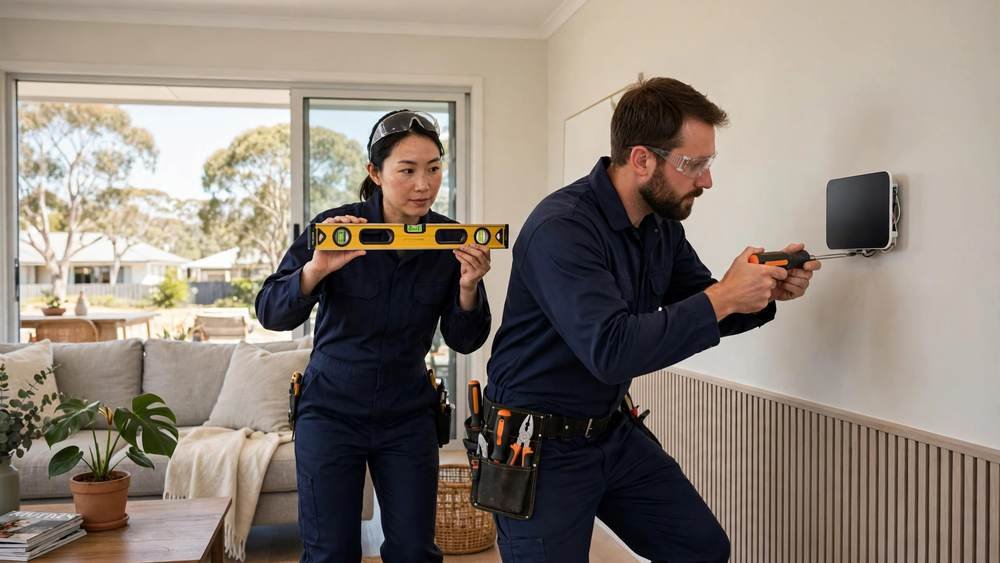
Professional alarm installation Australia households pay for is not a kit with a tradesperson attached. It is a designed system: zones planned for the house, cables run where they belong, a panel programmed for the household, and a certificate and warranty at the end. The question is not whether it costs more than DIY — it does — but what the extra money actually buys, and when the house needs it.
This guide covers what a professional install includes that DIY does not, when it is required rather than optional, what it costs, and how to check the installer before they touch a wall. Prices are Australian, checked on 15 November 2026. Our DIY alarm system guide covers the other side of the choice.
What professional installation actually includes
It starts before any tool comes out. The installer walks the house and designs the zones: which openings get a sensor, which rooms get a motion detector, where the keypad goes, where the panel lives, where the siren mounts. A three-bedroom house usually needs six to eight entry sensors and two motion sensors — but the count is the output of the walk-through, not a guess from a kit box.
Then comes the fitting: cables run through the roof space and down inside walls for wired sensors, detectors mounted at the height the manual states, the panel wired to mains power with its backup battery, the communicator connected for IP or 4G reporting. Then the programming: user codes for every regular user, entry and exit delays, stay and away modes, pet-immunity settings where they apply, and the monitoring procedure if the system reports to a control room.
Then the handover, which DIY never gets: a walk-through of the system with the household, a test of every sensor with the siren and the app alert at the same time, and the paperwork — an installation certificate where one is required, and a labour warranty. CTC Communications includes a 12-month labour warranty on its fixed-price packages, and its installers have been fitting alarms in Sydney since 1993. That paper trail is part of the product: it is what an insurer asks for, and what a monitoring provider checks before connecting the panel.
Professional alarm installation Australia: when it is required
Four situations need a professional install, not a preference but a requirement. The first is a monitored-alarm requirement: a commercial lease, a strata rule, or an insurer demanding a graded system needs a professional install and its certificate. A self-monitored kit does not satisfy it, and a monitoring provider generally requires the system to meet the Australian and New Zealand alarm standard AS/NZS 2201.2 before connecting it.
The second is a wired panel. A Bosch Solution 2000, 3000 or 6000 is a wired panel first, and fitting one means mains wiring, cable runs and programming that belong to a licensed trade. The third is a house with no reliable Wi-Fi: a wired panel with a cellular communicator is the answer, and fitting a communicator is installer work. The fourth is a roof space full of insulation, a two-storey house, or a household where nobody is comfortable with the app — all cases where the fitting itself is the hard part.
Our monitored alarm system guide covers who actually needs 24/7 response. If your household is in one of those groups, the professional install is not the expensive option — it is the only option that delivers what was asked for.
Professional alarm installation Australia: what it costs
A professionally installed Bosch Solution 2000 runs $1,020 fully installed in a Sydney fixed-price listing from CTC Communications, with a second Solution 2000 package at $1,067.33 and a touchscreen-codepad package at $1,404.38. Installer guides put a full alarm system at roughly $1,200 to $3,000. In Melbourne, one installer puts a properly installed house alarm with keypad, siren and detectors at $1,800 to $3,200, with cameras usually bringing the total to $4,000 to $6,500 for a family home.
Perth installer guides put professional installation fees at $100 to $300 for a basic job, $300 to $600 for a standard job, and $600 to $1,000 for a premium job — those are labour figures on top of the hardware, not all-in totals. The all-in figure is what matters, and it is the one to get itemised: panel, detectors, siren, communicator, programming, and the monitoring setup if any. A quote that leaves out the communicator or the programming is a quote that will grow.
DIY vs professional: the real comparison
The DIY kit is $215 for an Orion kit from Bunnings, or $349.95 for the eufy 5-in-1 when it is in stock, fitted in an afternoon with adhesive mounts and an app. The professional install is $1,020 and up. The gap is labour, design, certification and warranty — not hardware. A DIY kit saves the fitting cost and the wait, but you do the programming yourself, and there is no certificate at the end.
The comparison that matters is the job, not the price. A renter in a short lease, a small unit with one entry point, a household that is almost always home: DIY fits, and the kit moves house with you. A family home that needs monitoring, a house with a wired panel, a household with an insurer demanding a graded system: professional installation fits, and DIY does not deliver what was asked for. A house that needs the second should not buy the first to save $800.
How to check an installer before they touch a wall
Security installation is licensed work, and the rules vary by state. In Western Australia, installing, maintaining or repairing security alarm equipment for gain requires a security licence issued by WA Police under the Security and Related Activities (Control) Act 1996. In New South Wales, installers work under a Master Security Licence — CTC Communications lists Master Security Licence 000102543 for Mantr Group Pty Ltd — and in Victoria, installers hold a state security licence, such as the VIC Security Licence 937-301-20S held by one Melbourne installer. Ask for the licence number and check it on the register. A quote from an unlicensed installer is not a bargain: it is a system your insurer may not recognise and a monitoring provider may not connect.
Then check three more things. First, the ASIAL connection: the Australian Security Industry Association Limited is the industry body, and a member installer is making a claim you can check. Second, the brands: a Bosch Platinum Certified Partner can obtain discounted pricing and has the manufacturer’s backing, which matters when a panel needs warranty work. Third, the reviews and the references: an installer with 30 years in one city has a reputation to protect, and a new name with no local history is a risk to price in.
What good looks like on the day
A good install day has a shape to it. The installer arrives with the panel, the detectors, the cable and the tools — not a shopping list for you. They walk the house with you first, confirm the sensor positions, and explain what each one guards. They fit the panel and keypad, run the cables, mount the detectors at the right height, and program the system with you present: your codes, your delays, your modes.
Then they test it with you: every sensor tripped on purpose, the siren heard, the app alert seen, the monitoring centre called if the system reports to one. They leave you with the paperwork — the certificate where one is required, the warranty terms, the monitoring details — and a written list of what each sensor guards. If an installer finishes without testing every sensor with you present, the install is not finished. Say so before they leave.
Professional alarm installation Australia: the day itself, hour by hour
A standard install takes most of a working day, and knowing the shape of it helps you judge whether it went well. The first hour is the walk-through: the installer confirms the sensor positions with you, checks the roof access, finds the panel position and the power point, and agrees the keypad spot by the front door. If the walk-through does not happen — if the installer starts drilling before walking the house — stop them. The design is the job, and a design that skips the walk is a guess.
The middle hours are the fitting: cables run through the roof space and down inside walls, detectors mounted at the height the manual states, the panel wired to mains power with its backup battery, the communicator connected for IP or 4G reporting. This is the noisy part, and the part where a two-storey house or a slab-on-ground house takes longer than a single-storey house with an accessible roof. A good installer tells you when the drilling starts and what it will sound like, rather than leaving you to discover it.
The last hour is the programming and the handover, and it is the hour that separates professional alarm installation Australia households remember fondly from the kind they complain about. The installer programs your codes, your entry and exit delays, your stay and away modes, and the monitoring procedure if the system reports to a control room. Then they test it with you: every sensor tripped on purpose, the siren heard, the app alert seen, the monitoring centre called if the system reports to one. They leave you with the paperwork — the certificate where one is required, the warranty terms, the monitoring details — and a written list of what each sensor guards. If an installer finishes without testing every sensor with you present, the install is not finished. Say so before they leave, because after they leave, the visit becomes a second booking.
Red flags: the quotes to walk away from
Five red flags. A quote with no site visit for a finished two-storey house: the installer has not seen the wiring access, so the price is a guess. A quote that promises all-wired in a finished house without explaining which sensors will be wireless: the hybrid is normal, hiding it is not. A quote with no licence number, or a licence number that does not check out on the register.
A quote that bundles the equipment into a monthly figure without saying so: the hardware is effectively financed, and two apparently similar offers can differ by thousands across the term. And a quote that prices the install but not the monitoring setup, the communicator, or the permits: the cheapest quote that excludes everything is usually more expensive than the cheapest quote that includes it. Get three quotes, make them answer the same questions, and compare the itemised totals.
Frequently asked questions
Is professional alarm installation worth it in Australia?
Professional alarm installation Australia is worth it for a family home that needs monitoring, a wired panel, or an insurer-recognised system: the design, wiring, programming, certificate and warranty are the product, not just the hardware. For a renter or a small unit, a $215 DIY kit is usually the better buy. The deciding question is the job, not the price.
How much does professional alarm installation cost in Australia?
A Bosch Solution 2000 fully installed is $1,020 in a Sydney fixed-price listing, with a touchscreen package at $1,404.38. Installer guides put a full system at roughly $1,200 to $3,000, and a Melbourne installer puts a properly installed house alarm at $1,800 to $3,200. Each additional sensor runs about $90 to $180.
Do alarm installers need a licence in Australia?
Yes — security installation is licensed work, and the rules vary by state. In Western Australia a security licence issued by WA Police is required. Ask for the licence number and check it on the register before you accept a quote.
What warranty comes with a professional alarm installation?
It varies by installer. CTC Communications includes a 12-month labour warranty on its fixed-price packages, and Ajax hardware carries a 24-month manufacturer warranty. Ask for both the labour warranty and the hardware warranty in writing before the work starts.
Can a professional installer take over my existing alarm?
Often, yes. An installer can take over an existing wired panel, reuse the wiring and detectors where they are compatible, and upgrade the panel and keypad. The panel usually needs to meet AS/NZS 2201.2 before a monitoring provider will connect it, so an old or non-compliant panel may need repair first.
Prices checked 15 November 2026 from CTC Communications and Australian installer guides. Planning figures, not quotes. External price source: CTC Communications home alarm installations.