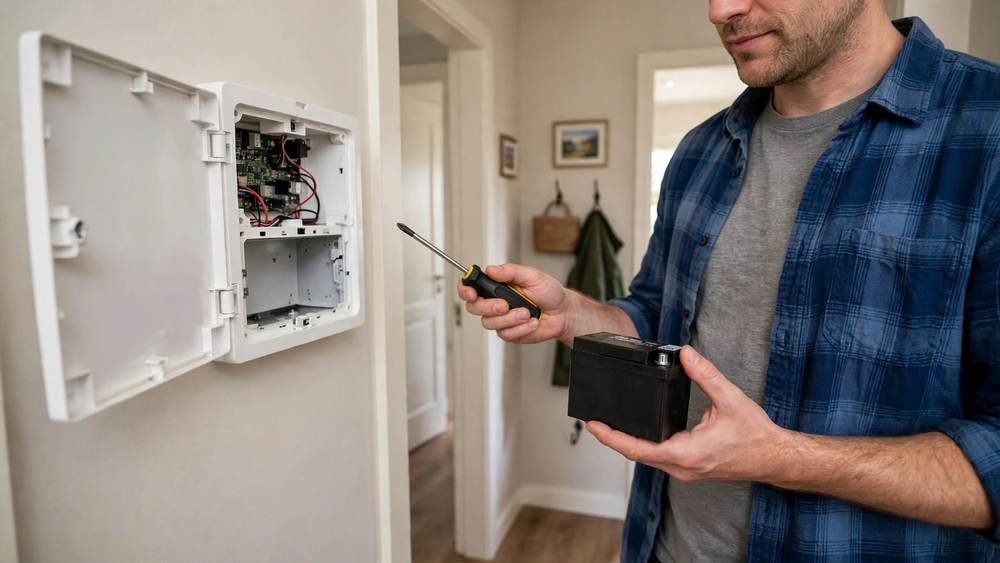
Alarm battery replacement Australia households put off is the cheapest job in home security, and the one whose failure costs the most. A panel battery costs $25.99. A flat one costs you the alarm in the first proper blackout — no detection, no siren, no signal, just a box on the wall. This guide covers which battery your system takes, how to swap it safely, and when to stop waiting.
Prices are Australian, checked on 15 November 2026. Our best home alarm system guide compares the panels these batteries keep alive.
Which battery your alarm takes
Most Australian wired panels take the same battery, and alarm battery replacement Australia wide usually means this one battery: a 12-volt 7Ah sealed lead-acid battery. CTC Communications lists one at $25.99, suitable for Bosch, Hills Reliance and DSC security systems, and for UPS devices. A Bosch-branded 12-volt 7Ah battery is $28 from CCTV Importers, down from $49. The two are interchangeable for the panels they suit — the specification is 12 volts and 7 amp-hours, sealed lead-acid, with the same terminal layout — but check your panel’s manual before buying, because some panels take a different size.
Wireless sensors take their own batteries, and they vary by sensor: coin cells, AA cells, or proprietary packs, depending on the brand. The eufy entry and motion sensors, the Orion sensors, and most wireless detectors run on batteries that last a year or two, and the app reports their levels. The siren has its own battery too, in most wired systems, and it is usually the same 12-volt type as the panel battery — check the siren’s manual rather than assuming.
One warning before you buy: alarm batteries are consumable items, and they are not covered for panel faults or power supply failures. A new battery will not fix a panel that cannot charge one. If the panel reports a battery fault with a new battery fitted, the fault is the panel or its charger, not the battery — and that is a technician’s job, not a second battery.
Alarm battery replacement Australia: the panel battery, step by step
Do this on a Saturday morning, not at 10 pm. First, tell the monitoring centre if the system is monitored: a panel with its power disconnected can report a fault, and a fault the centre does not know about becomes a patrol attendance with a bill attached. Put the system into test or maintenance mode through the app or the keypad if it has one.
Second, open the panel and find the battery. It is the black rectangular block in the bottom of the panel box, with two spade terminals — red for positive, black for negative. Take a photo of the wiring before you touch anything: the photo is the map back if you get interrupted. Third, disconnect the mains power to the panel first, then the battery terminals — negative first, then positive. The order matters: disconnecting the battery while the mains is still live can cause a fault the panel remembers.
Fourth, lift the old battery out and put the new one in the same way around. Connect the terminals — positive first, then negative — and confirm they are tight: a loose terminal is a battery that reads fine at rest and collapses under load. Fifth, restore the mains power, close the panel, and watch the keypad: the low-battery warning should clear within a few minutes. Sixth, test it: arm the system, trip a sensor, and confirm the siren and the app alert both work. Then write the date on the new battery with a marker — the install date is the schedule.
The whole job takes about fifteen minutes and one screwdriver. If any step does not match what you see — a different battery size, a swollen or leaking battery, terminals that are corroded green — stop and call a technician. A swollen sealed lead-acid battery is a battery to handle carefully: do not puncture it, do not charge it, and take it to a battery recycler rather than putting it in household rubbish.
Alarm battery replacement Australia: when to replace
A 12-volt sealed lead-acid battery lasts three to five years, sometimes sooner in hot conditions. Replace it at year four whether it complains or not, because a battery past its best might only hold a charge for 30 minutes rather than a full day — and you will not discover that until the first proper blackout. The panel’s low-battery warning is the last resort, not the schedule: by the time the panel complains, the battery has been weak for months.
The signs are worth knowing anyway. A panel that beeps about a low battery after a short outage. A system that dies within an hour of the power going out, when it used to last a day. A battery that reads a little over 13 volts when fully charged and drops below 12.5 volts under load — if you own a multimeter, that reading is the test: a good battery holds 12.5 volts or higher under load, and a battery that drops below it is done. A battery that takes a day or so to recharge after being drained heavily is normal; a battery that never reaches full charge is not.
Sensor batteries follow a different clock: replace them when the app reports low, typically every one to two years. Do not wait for the sensor to go silent — a sensor with a flat battery quietly stops reporting, and a system that misses one monthly test is a system to fix, not to trust. Check battery levels in the app on the first of the month, the way you check smoke alarm batteries.
Sensor batteries: the small job people skip
Sensor batteries are the maintenance people skip because each one is small. One entry sensor’s battery is a few dollars and two minutes. A house with eight entry sensors and two motion sensors is ten batteries on a rolling cycle — and the cycle is the point: they do not all go flat at once, they go flat one at a time, silently, over months. The app is the only warning, and only if you look at it.
Buy the right cell for the sensor: the manual names it, and the old battery has it printed on it. Keep a small stock at home — a pack of the cells your sensors take — so a low-battery alert is a two-minute job instead of a trip to the shops. And replace sensor batteries in pairs where the manual suggests it: a motion sensor with one fresh cell and one tired cell is a sensor with a tired cell.
Pet-friendly sensors deserve a note here. Pet immunity works by the detector’s design and its mounting height — usually around 2 metres — and a detector with a weak battery can lose the sensitivity its pet immunity depends on. If a pet-friendly sensor starts tripping on the cat, check its battery before you blame the cat.
The same rolling cycle applies to the siren’s battery and to any wireless keypad or fob: they are small cells on the same one-to-two-year clock, and they go flat one at a time rather than all at once. Alarm battery replacement Australia households plan for is therefore a small annual habit, not a single event — a pack of the cells your sensors take, a note of the date each one was changed, and a monthly glance at the app. The household that treats sensor batteries as a habit never discovers a flat one during a break-in, and the household that treats them as an afterthought discovers it at exactly the wrong moment.
What a new battery does not fix
A new battery does not fix a panel that cannot charge it. If the panel reports a battery fault with a new battery fitted, the charger or the panel is the fault — call a technician. A new battery does not fix a system that false-alarms: a sensor facing a heater, a loose entry sensor, a curtain in the sun — those are placement faults, and a fresh battery changes nothing.
A new battery does not fix a communication path either. A panel whose only path is the internet goes silent when the modem dies, battery or no battery, and a 3G communicator no longer works at all in Australia. If the alarm’s problem is that nobody hears about it, the fix is a 4G communicator or a dual-path setup, not a battery. Our monitored alarm system guide covers the reporting paths, and our wireless alarm system guide covers the kits whose sensors run on these batteries.
Disposal: what to do with the old battery
A sealed lead-acid battery is not household rubbish. Take it to a battery collection point — most battery retailers take old ones back, and many councils run drop-off points. Do not puncture it, do not burn it, and do not leave a swollen battery in the house: a swollen battery is a failed battery, and it should go to a recycler promptly. Keep the old battery upright in transport, terminals covered, and out of reach of children.
The same applies to sensor batteries: coin cells and AA cells go to battery recycling, not the bin. A small box by the door for dead batteries, emptied when you pass a collection point, is the whole system. It costs nothing and it keeps lead and lithium out of landfill.
One battery a year is the normal shape of it. Alarm battery replacement Australia households do once every few years leaves one old panel battery and a handful of sensor cells to dispose of — a single trip to a collection point, not a project. Keep the old panel battery upright in transport, terminals covered, and out of reach of children, and take it in within the week rather than leaving it in the garage for a year. A battery that has finished its service deserves a prompt trip to the recycler, not a slow one to the bin.
Frequently asked questions
How much does an alarm battery replacement cost in Australia?
For alarm battery replacement Australia wide, a 12-volt 7Ah sealed lead-acid panel battery costs $25.99 from CTC Communications, and a Bosch-branded one is $28 from CCTV Importers. Sensor batteries cost a few dollars each. The swap itself takes about fifteen minutes and one screwdriver, or a technician can do it as part of an annual service visit.
How long does a home alarm battery last?
Three to five years for a 12-volt sealed lead-acid panel battery, sometimes sooner in hot conditions. Sensor batteries last one to two years. Replace the panel battery at year four on a schedule, not when it fails — a battery past its best might only hold a charge for 30 minutes in a blackout.
Can I replace an alarm battery myself?
Yes, in most cases: disconnect the mains first, then the battery terminals — negative first — swap the battery, reconnect positive first, restore the mains, and test. Tell the monitoring centre first if the system is monitored. If the battery is swollen, leaking or corroded, or the panel still reports a fault with a new battery fitted, call a technician.
What battery does a Bosch alarm panel take?
Most Bosch panels take a 12-volt 7Ah sealed lead-acid battery — the same battery Hills Reliance and DSC panels use. A Bosch-branded 12-volt 7Ah battery is $28 from CCTV Importers, and a compatible one is $25.99 from CTC Communications. Check your panel’s manual before buying, because some panels take a different size.
Why does my alarm beep about a low battery?
The panel battery is weak, a sensor battery is low, or the panel’s charger is failing. Check the app for which battery it names, replace that battery, and watch whether the warning clears. If a new battery does not clear it, the fault is the panel or its charger — call a technician rather than buying a second battery.
Prices checked 15 November 2026 from CTC Communications and CCTV Importers. Planning figures, not quotes. External price source: CTC Communications 12V 7Ah alarm battery.