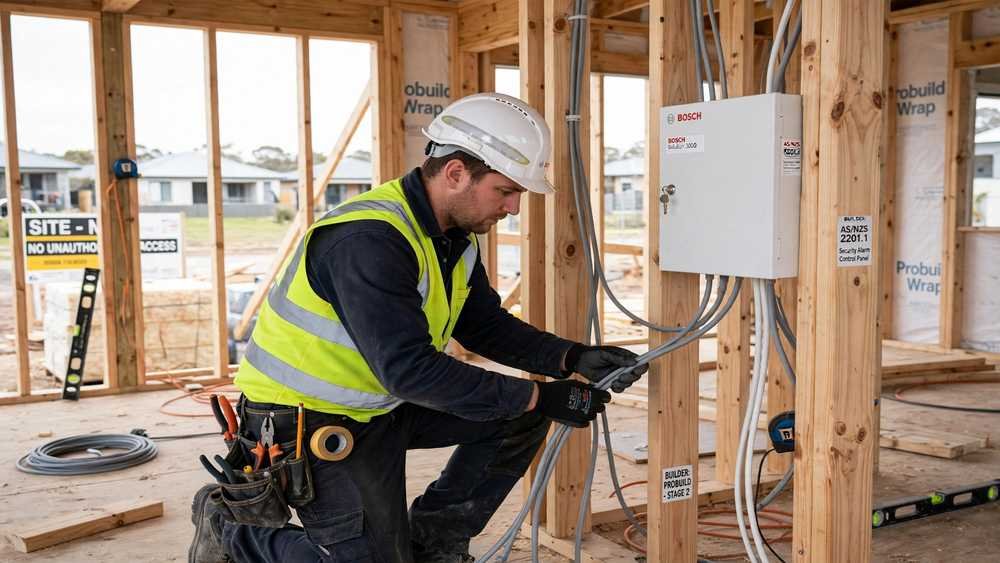
A wired alarm system Australia installers still fit is not old-fashioned. It is a panel on the wall with cables running to every sensor — no batteries in the detectors, no wireless signal to jam or drop, no sensor quietly going flat. In a new build or a renovation, when the walls are open anyway, wired is often the better system and sometimes the cheaper one.
This guide covers when wired wins, what it costs installed, which panels Australian installers actually fit, and the cases where wireless is the smarter buy. Prices are Australian, checked on 15 November 2026. Our best home alarm system guide compares the panels behind both types.
What a wired alarm system actually is
One panel, many cables. The control panel sits in a cupboard or a roof space, with a keypad by the front door. From the panel, cables run to each detector: door and window contacts, motion sensors, the internal siren, the external siren and strobe. Each detector is powered through its cable, so there are no sensor batteries to change and no wireless range to worry about.
The panel itself plugs into mains power and holds a backup battery — usually a 12-volt sealed lead-acid battery — that keeps it running through a blackout. A wired system reports to a monitoring centre through a communicator, IP or 4G, the same way a wireless panel does. The difference is all inside the house: cable instead of radio, between the panel and the sensors.
Wired alarm system Australia: when wired still wins
Wired wins in four situations. The first is a new build: when the frame is up and the walls are open, running alarm cable costs little extra, and the finished house has sensors everywhere with nothing to maintain. The second is a renovation: if the plaster is already coming off, the cabling goes in with the electrical work and disappears for decades.
The third is reliability. A wired sensor cannot run out of battery, cannot lose its wireless link, and cannot be jammed by a cheap radio device. For a large house, a house with thick brick walls, or a house with sensors in a shed or a detached garage, cable beats radio on every measure that matters. The fourth is a monitored or graded system: insurers and monitoring providers like wired panels, because a wired panel is harder to defeat and easier to certify to the Australian and New Zealand alarm standard AS/NZS 2201.
Our monitored alarm system guide covers who actually needs 24/7 response; a wired panel is the usual starting point for those households.
What a wired system costs installed
Most wired panels are sold installed rather than off a shelf, so the honest price is the installed package. CTC Communications lists a Bosch Solution 2000 fully installed at $1,020 in Sydney — panel, sensors, communicator and programming included — with a second Solution 2000 installed package at $1,067.33 and a touchscreen-codepad package at $1,404.38. A larger Bosch Solution 6000 runs about $1,966 in one Sydney listing for an alarm plus back-to-base monitoring deal.
Installer guides put a full alarm system at roughly $1,200 to $3,000, with one published example at about $2,100 upfront plus $40 a month for monitoring. In the ACT, installer guides put a basic three-zone wired system at $800 to $1,400, a standard home with six to eight zones at $1,400 to $2,400, and a larger or two-storey home at $2,400 to $3,500, with each additional sensor at $90 to $180. In Western Australia, guides put a basic wired system at $700 to $1,800 supplied and installed, and a standard wired system with more zones at $1,500 to $3,000. In Melbourne, one installer puts a properly installed house alarm with keypad, siren and detectors at $1,800 to $3,200.
What changes the price is zones, wiring access and storeys. A single-storey house with an accessible roof space is the cheap job: cables drop straight down the walls. A two-storey house, a slab-on-ground house with no roof access, or a house with solid brick internal walls costs more, because every cable is a job of its own. A house under construction is different again: the cabling goes in during the build, which is why a wired panel for a new build can cost less installed than the same panel retrofitted into a finished house.
The panels Australian installers actually fit
The panel most Australian installers fit is Bosch. The Solution 2000 is the entry point: 8 fully programmable wired zones, suited to smaller and standard-sized homes that need straightforward protection — a few door contacts, a few motion detectors, an internal siren and a backup battery. CTC Communications calls it the best-value choice for smaller Sydney homes, and it is NBN-ready with an optional Bosch B426-M IP module for app control and internet reporting.
The Solution 3000 steps up the zone count and the keypad options, including a touchscreen codepad, for homes that need more detectors or a nicer interface. The Solution 6000 is the large-home panel, with the most zones and the most expansion, and it is the panel installers in Brisbane say they fit in more homes than any other for monitored systems. All three are wired panels first, with wireless detectors available as an add-on — which is how most real installs end up: wired where the cable can run, wireless where it cannot. That hybrid is the honest answer for an established house.
Hills is the other Australian name you will hear: the Hills Reliance panel is a long-standing wired panel in Australian homes, and its 12-volt 7Ah backup battery is the same sealed lead-acid battery the Bosch panels use — $25.99 from CTC Communications. If your house already has a Hills panel, a takeover and upgrade is usually cheaper than a full replacement, and the existing wiring is the asset.
Wired vs wireless: the honest comparison
Wireless wins on install speed and on established houses. A wireless kit like the eufy 5-in-1 at $349.95 or the Orion kit at $215 from Bunnings goes up in an afternoon with adhesive mounts and an app, no cables, no holes, no electrician. For a renter, that is the whole argument: the kit moves house with you. Our wireless alarm system guide compares the kits.
Wired wins on the long run. No sensor batteries to change every year or two. No wireless dropouts. No jamming. A wired sensor lasts as long as the cable does, and the cable lasts as long as the house does. The running cost is a panel battery every three to five years — $25.99 for a 12-volt 7Ah battery — against a wireless house full of sensor batteries on a rolling replacement cycle.
The deciding question is simple: are the walls open? If yes, wire it. If no, and the house is established with finished walls, wireless — or a hybrid with wired where the cable can run — is the sensible buy. Paying to chase cables through finished walls is the one job that makes wired cost more than it is worth.
Wired alarm system Australia: the hybrid most houses end up with
Most real installs are neither all-wired nor all-wireless. They are hybrid: wired sensors where the cable can run, wireless sensors where it cannot. A wired alarm system Australia installers fit in an established house usually looks like this — wired on the front door, the hallway and the living room, where the roof space gives easy access, and wireless on the detached garage, the extension, or the rooms with no roof access above them.
The hybrid keeps the wired advantages where they matter most: no batteries on the main sensors, no wireless dropouts on the main paths, and a panel that is harder to defeat on the entries a burglar would use first. It avoids the one cost that makes wired expensive in a finished house: chasing cables through walls that are already closed. The programming is one panel either way — Bosch panels take wireless detectors as an add-on — so the household gets one app, one keypad, one set of codes, and a system that behaves as a single alarm rather than two.
The trade is honest and worth stating plainly. The wireless detectors bring back the battery replacement the wired sensors avoid, so a hybrid house has a small rolling battery job — a few sensor batteries every year or two, checked in the app on the first of the month. The wired sensors need nothing. For most established houses, that is the right split: cable where it is easy, radio where it is not, and a written list of which sensor is which so the battery job never becomes a guessing game.
New builds: getting the cabling right the first time
A new build is the one chance to do wired properly and cheaply. The cabling goes in during the frame stage, before the plaster, and it needs a plan: a sensor position for every ground-floor opening, a motion sensor position for every room a burglar would cross, a keypad position by the front door, a siren position high on an outside wall, and a panel position in a cupboard with power nearby. The panel needs mains power and, if it reports over IP, a network point.
Two visits are normal for a house under construction: the first to run the cables, the second to fit the panel and detectors after the plaster and paint. A quote that prices only one visit is a quote that has missed the second one. Tell the builder early — the alarm cabling is an electrical trade, and it belongs in the electrical plan, not as an afterthought when the walls are already closed.
Retrofitting wired into a finished house
Retrofitting a wired alarm system Australia households already live in is possible, and it is where wired gets expensive. Cables run through the roof space and drop down inside walls, which works well in a single-storey house with a pitched roof and plaster walls. It works badly in a house with a flat roof, a concrete slab and no roof access, or solid brick internal walls — every cable becomes a surface run or a chased channel, and the cost climbs with each one.
The honest rule: get the installer to walk the house before quoting, and ask which sensors will be wired and which will be wireless. A good installer will wire the sensors that are easy to reach — the front door, the hallway, the living room — and put wireless detectors where the cable cannot sensibly go. A quote that promises all-wired in a finished two-storey house without a site visit is a quote to question.
Frequently asked questions
Is a wired alarm system better than wireless in Australia?
A wired alarm system Australia installers fit is usually the better choice for a new build or a renovation: no sensor batteries, no wireless dropouts, and a panel that is harder to defeat. For an established house with finished walls, wireless is usually the better buy, because chasing cables through finished walls costs more than the reliability is worth. Most real installs end up hybrid — wired where the cable can run, wireless where it cannot.
How much does a wired alarm system cost in Australia?
A Bosch Solution 2000 fully installed runs $1,020 in a Sydney installer listing, with a touchscreen package at $1,404.38. Installer guides put a full system at roughly $1,200 to $3,000, a basic three-zone system in the ACT at $800 to $1,400, and a standard six-to-eight-zone home at $1,400 to $2,400. Each additional sensor runs about $90 to $180.
Can I add wireless sensors to a wired alarm panel?
Yes. Bosch panels take wireless detectors as an add-on, and most installers fit a hybrid: wired sensors where the cable can run, wireless where it cannot. The wireless detectors need their own batteries, so they bring back the battery replacement the wired sensors avoid.
Does a wired alarm need the internet?
Only for app alerts and internet reporting. The panel, sensors and siren all work locally without it. If the system reports to a monitoring centre, it needs a path — IP over the internet, or a 4G communicator that keeps reporting when the NBN is down.
How long does a wired alarm system last?
The cabling lasts as long as the house. The panel battery needs replacing every three to five years — a 12-volt 7Ah battery costs $25.99 — and the panel itself can serve for well over a decade, with upgrades usually meaning a new panel and keypad on the existing wiring rather than a full rewire.
Prices checked 15 November 2026 from CTC Communications and Australian installer cost guides. Planning figures, not quotes. External price source: CTC Communications Bosch installation packages.