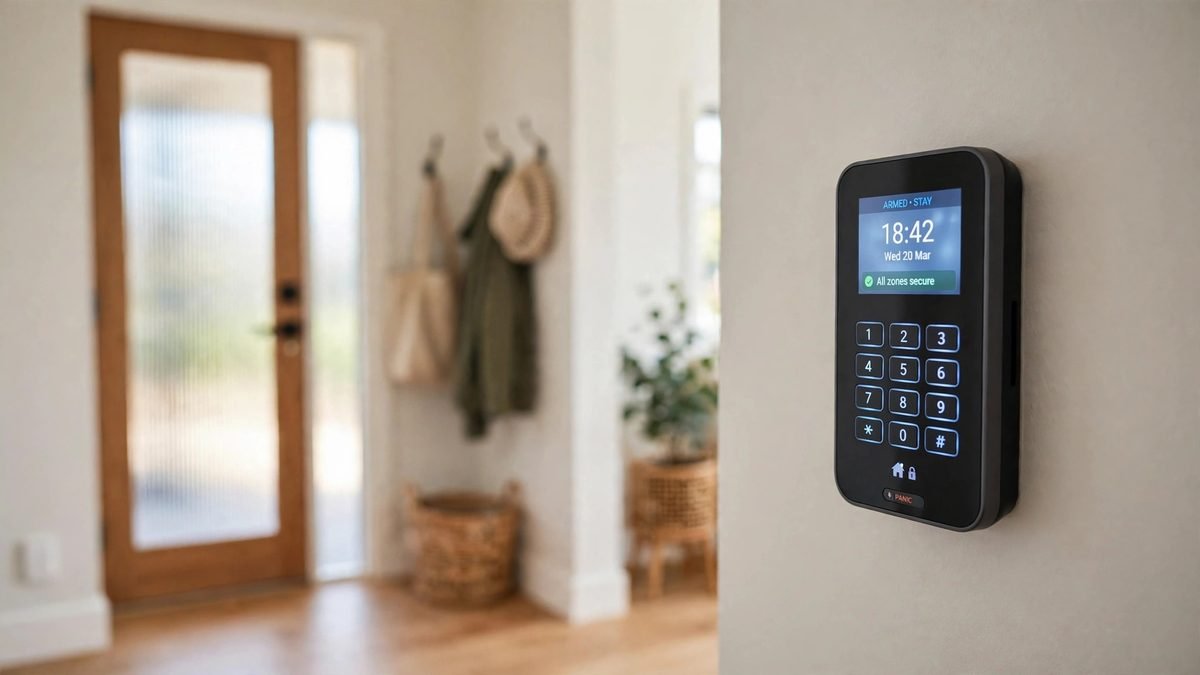
Shopping for the best home alarm system in Australia gets confusing fast, because most guides mix up two different things: the alarm panel that runs the system, and the whole security setup around it. This guide is about the panel — the box on the wall, its zones, its sensors and its monitoring path. If you want the whole-system view, cameras and all, our best home security system guide covers that separately. Here, we stay on panels, and we compare them the way an installer would: zones first, wiring second, price last.
Every price below comes from Australian supplier or installer listings checked in November 2026. Most professional panels are sold installed rather than off a shelf, so where a figure is a kit price it is labelled as one, and where it is an installed package it says so. Prices move, and a quote for your house will depend on its size and wiring — treat these as planning figures, not quotes.
How we compared alarm panels
Five things decide whether an alarm panel is right for an Australian home:
- Zones: how many separate sensor groups the panel can handle. A small unit might need 8; a large two-storey house can need 16 or more.
- Wiring: wired panels are the most reliable but suit new builds and renovations; wireless panels suit established homes; hybrid panels take both.
- Monitoring path: whether the panel can call your phone, a monitoring centre, or both — and whether it still works when the internet drops.
- App and keypad: how you actually arm, disarm and check the system day to day.
- True cost: panel and sensors plus installation plus any monthly monitoring, not just the box price.
We did not rank panels on marketing claims. We judged each contender for the best home alarm system in Australia on zone capacity, wiring flexibility, Australian availability and published Australian pricing.
The best home alarm panels at a glance
| Panel | Type | Zones | Price guide (Nov 2026) | Best for |
|---|---|---|---|---|
| Bosch Solution 2000 | Wired | 8 | From about $1,020 fully installed (Sydney) | Smaller homes, straightforward protection |
| Bosch Solution 3000 | Hybrid | 16 | Kit from about $1,534 in one listed configuration | Most family homes, wired plus wireless |
| Bosch Solution 6000 | Hybrid + access control | Up to 144 | About $1,966 in one installed + monitoring deal | Large homes and small businesses |
| Hills Reliance XR / XR Pro | Hybrid | Up to 128 | Panel kits about $445 (XR) / $608 (XR Pro) | Growing families, easy expansion |
| Hikvision AX Pro | Fully wireless | Expandable | Price not verified at write time | Established homes, app-first buyers |
Kit prices exclude installation unless stated. Confirm the current price with the supplier before buying.
1. Bosch Solution 2000 — best for smaller homes
Price: from about $1,020 fully installed in a Sydney installer listing. Zones: 8 fully programmable wired zones.
The Solution 2000 is the entry point into Bosch’s Australian range, and it suits smaller and standard-sized homes that need straightforward protection: a few door contacts, a few motion detectors, an internal siren and a backup battery. It takes four keypad styles, and an optional smartphone module can send alarm activations to your mobile.
Its limit is its strength: 8 wired zones keep it simple, but a larger home will run out of zones quickly, and wired detectors mean cable runs. If your home is already built and you want to avoid chasing walls, look at the hybrid options below instead. For a small home or unit with clear wiring access, this is the cheapest way into a professionally installed Bosch panel.
2. Bosch Solution 3000 — best all-rounder for family homes
Price: one listed kit configuration — panel with two wireless detectors, a 5-inch touchscreen code pad and an IP module — at $1,533.78 from an Australian security supplier. Zones: 16 programmable zones, wired or wireless.
The Solution 3000 is the panel most Australian family homes end up with, because it removes the either-or choice. Wired detectors go where cable is easy, wireless detectors go where it is not, and the panel handles both. Detector options include standard PIR, quad-element and Tritech models, and keypad choices run from a basic icon code pad to a touchscreen.
The IP module matters more than it sounds: it is what lets the panel send alerts to your phone and, with a monitoring plan, report to a monitoring centre over the internet. If you are comparing quotes, check whether the IP module is included — a cheaper quote without it is not the same system.
3. Bosch Solution 6000 — best for large homes
Price: about $1,966 in one Sydney listing for an alarm plus back-to-base monitoring deal. Zones: from 16 up to 144 with expansion, plus access control.
The Solution 6000 is enterprise-grade hardware that also fits large homes: it combines intrusion detection with access control, so the same panel can run the alarm and control who can open particular doors. Wi-Fi, wireless options and remote controls are available, and the zone count scales far beyond anything a normal house needs.
For most homes this is more panel than necessary, and you should not pay for it unless you have the size or the access-control need to justify it. For a large property, a home business, or a house with outbuildings on the same system, it is the scalable choice.
4. Hills Reliance XR and XR Pro — best hybrid for growing families
Price: panel kits listed at about $445.08 (XR) and $607.86 (XR Pro) from an Australian security supplier, before sensors and installation. Zones: up to 128 zones, 8 areas, up to 99 users.
Hills Reliance is the other mainstream Australian hybrid panel, and its pitch is expansion: start with the openings and rooms you need now, add detectors as the family or the house grows, and run it all from the UltraSync+ mobile app. The XR Pro adds capacity over the standard XR for bigger or more complex layouts.
Choose Hills over Bosch when the app experience and the upgrade path matter more to you than the badge, or when your installer already works with Hills — installer familiarity is worth more than a spec-sheet difference, because the installer is who you call when something beeps at 2am.
5. Hikvision AX Pro — best fully wireless panel
Price: not verified at write time, so no figure is stated here. Type: fully wireless, app-controlled, expandable.
The AX Pro suits established homes where running cable is impractical: everything connects wirelessly, the app controls arming and alerts, and video verification is available where cameras are part of the setup. Setup is simpler than a wired panel, which is why it appeals to buyers who want a professional-grade panel without a renovation.
The trade-off with any fully wireless panel is battery and signal management: sensors run on batteries that need replacing, and the panel’s placement matters for reliable reception. Get a quoted price from an Australian supplier before comparing it against the Bosch and Hills figures above — an unpriced option cannot win a value comparison.
Ajax wireless alarms — worth a look
Ajax is the other wireless name Australian installers quote regularly: encrypted wireless signalling, outdoor detectors for yards and sheds, and app control. No kit price is stated here because none was verified from an Australian supplier at write time. If you are quoted Ajax, compare it against the AX Pro on the same basis — panel, sensor count, app features and monitoring path — rather than on a headline kit price that may exclude the sensors you actually need.
Self-monitored or back-to-base?
The panel is only half of choosing the best home alarm system. The other half is who responds when it goes off.
Self-monitoring means the panel alerts your phone and you decide what to do. It costs nothing monthly, and it suits people who are usually reachable and comfortable calling police or a neighbour themselves. Its weakness is obvious: if you are asleep, overseas, or out of coverage, nobody else is watching.
Back-to-base monitoring means a monitoring centre receives the signal and escalates it — to you, to a patrol, or to emergency services, depending on the plan. Australian guides put standard monitoring at roughly $25 to $60 a month ($300 to $720 a year) for signal reception and escalation alone. Plans that include patrol or guard response run roughly $80 to $130 a month, and attendance fees can sit outside the subscription. Activation, communicator hardware and call-out charges are often separate line items, so read the quote, not just the monthly figure.
Two Australian specifics matter here. First, the 3G shutdown: Australia’s major carriers have retired their 3G networks, so an older communicator that depends on 3G may no longer deliver signals at all — if you are taking over an old panel, check its communicator before paying for monitoring. Second, monitoring providers generally require the system to meet the Australian/New Zealand alarm standard AS/NZS 2201.2 before they will connect it; a non-compliant old panel may need repair first.
What installation really costs
The best home alarm system for your home is rarely the cheapest panel, because installation is where the total moves. Melbourne installer guides put professional installation labour roughly between $300 and $1,000 depending on the property, while DIY wireless kits run roughly $150 to $700 for equipment alone. Installed packages from Melbourne providers commonly land between $1,500 and $5,000 once panel, sensors, labour and setup are combined.
That range is wide because houses are wide: a single-storey brick home with roof access is a different job from a double-storey home with concrete floors. Get two or three itemised quotes — panel model, sensor count, keypad type, communicator, monitoring terms — and compare them line by line. A quote that hides the sensor count is not comparable to one that lists it.
Choosing the best home alarm system by house size
Zones are the simplest way to size a panel. A unit or small two-bedroom home usually fits in 8 zones: front door, back door, a few windows and one or two motion detectors. A three- or four-bedroom family home typically needs 16 zones once every external door, vulnerable window and living area is covered. Beyond that — large homes, home businesses, sheds on the same system — you are in Hills XR or Bosch 6000 territory, and the panel choice matters less than the sensor plan.
One practical tip: leave spare zones. A panel run at full capacity on day one has nowhere to grow when you add a shed sensor or a garage door contact later. Buying the next size up is usually cheaper than replacing the panel.
A warning about US prices
If you search for alarm prices online, you will find plenty of US figures — Ring Alarm kits around US$199 and monitoring around US$20 a month, SimpliSafe kits from around US$245 with monitoring from around US$20 a month. Those are American prices for American plans, and they are not Australian prices. No current Australian-dollar kit price for those brands was verified from an Australian retailer at write time, so none is stated here. Before you buy any imported kit, confirm it is sold and supported in Australia, that its monitoring works here, and what the Australian plan actually costs.
Frequently asked questions
Which alarm panel suits a three-bedroom Australian home?
A 16-zone hybrid panel such as the Bosch Solution 3000 or a Hills Reliance XR is the usual fit: enough zones for every external door and vulnerable window plus living-area motion detection, with room to add wireless sensors later without replacing the panel.
Is a wired or wireless alarm panel better?
Wired panels are the most reliable and never need sensor batteries, which suits new builds and renovations where cable can be run. Wireless panels suit established homes where cabling is impractical. Hybrid panels take both, which is why they suit most existing homes.
Does an alarm panel need back-to-base monitoring?
No. A panel works fine self-monitored, alerting your phone when it triggers. Back-to-base monitoring, at roughly $25 to $60 a month in Australia, adds a monitoring centre that escalates signals when you cannot respond yourself. It is worth it if you are often away, asleep, or out of coverage.
What happens to my alarm in a power or internet outage?
A properly installed panel keeps working on its backup battery during a blackout, though the length of cover depends on the battery and the sensor load. Internet outages are a different risk: a panel that reports only over IP cannot signal while the modem is down, which is why dual-path panels with a cellular backup are worth asking about.
Will my old alarm panel still work after the 3G shutdown?
The panel itself still works as a local alarm, but if its communicator depends on 3G, it can no longer send signals to a monitoring centre, because Australia’s major carriers have retired their 3G networks. Check the communicator type before paying for monitoring on an older panel.
Prices checked November 2026 from Australian supplier and installer listings, including CTC Communications for Bosch and Hills kit figures and Australian monitoring guides for back-to-base ranges. Prices move with sales and vary by property — confirm on the supplier page and in an itemised quote before buying. Panel kit figures exclude installation unless stated. External price source: CTC Communications Bosch alarm range.