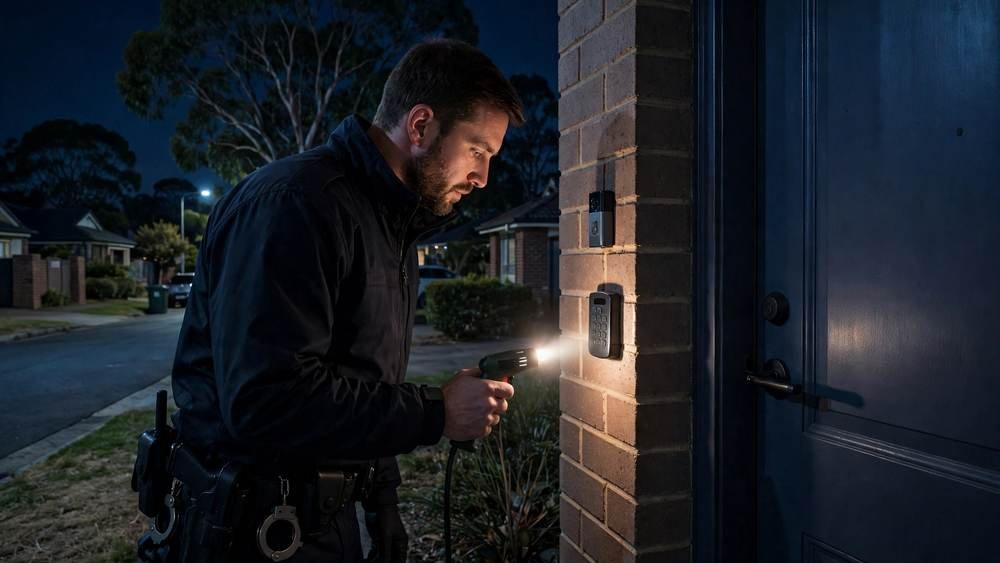
False alarm fees Australia households face are not one charge. They are three different bills under three different rules: the patrol attendance your monitoring provider sends, the police charge for repeated false security alarms, and the fire-brigade charge for false fire alarms. Mixing them up is how a $70 patrol visit gets quoted as a $1,656 fire charge, and how a real $1,656 bill arrives as a surprise.
This guide separates the three false alarm fees Australia households face, state by state, with the figures published for 2026, and covers the waivers that can remove a charge if you apply in time. Figures checked on 15 November 2026; the Victorian figure re-checked 23 November 2026. Our alarm monitoring cost guide covers the monthly fee these charges sit on top of.
False alarm fees Australia: the three different bills
First, the patrol attendance. When a monitoring centre sends someone to your property — a patrol guard, a technician — that attendance is usually billed separately, unless your plan says otherwise. Indicative patrol attendance runs about $70 to $150 per activation, and some providers list alarm response from $50 per attendance, with two free false-alarm attendances a month on eligible systems they installed and monitor. That is the detail to look for in a monitoring plan: how many free attendances a month, what each extra one costs, and what happens after repeated ones.
Second, the police charge. Under section 209 of the NSW Police Act 1990, police may charge the owner or occupier of a building for attending false security alarms at non-residential premises, where there has been more than one false alarm within a 28-day period. The NSW Police Force cost-recovery schedule lists $1,600 for such an attendance. Some older guides cite $200 per qualifying response after the first — the police schedule is the authority, so go by the schedule and check it before relying on a historic figure. The provision presumes the alarm false unless the owner establishes otherwise, and it applies to non-residential premises — a home alarm is treated differently from a shop alarm, which is why the distinction matters.
Third, the fire-brigade charge. This is for fire alarms, not burglar alarms, but it shows the scale: a preventable fire-alarm attendance can dwarf a monthly monitoring bill. Fire Rescue Victoria lists $657+ per truck per 15 minutes for the 2026–27 financial year, with reasonable or non-preventable events potentially exempt. Western Australia’s fire service lists $1,337 per false fire-alarm attendance for 2025–26. New South Wales charges $1,656 per chargeable false alarm, and the ACT charges building owners $2,000. Those are government charges, not provider fees — but the lesson carries over to security alarms: a sensor that false-alarms monthly is a recurring bill.
What each state charges for false fire alarms
The state figures below are for false fire-alarm attendances, from published guides checked on 15 November 2026. They are not security-alarm patrol fees, and they should not be quoted as such. New South Wales charges $1,656 per chargeable false alarm, with a 180-day waiver deadline. Victoria bills $657+ per truck per 15 minutes for 2026–27, with a 14-day window from the invoice to apply for a waiver. Queensland is listed at $1,557 in one state-by-state guide, with a dispute on Form OM201. Western Australia lists $1,337 per false fire-alarm attendance for 2025–26, with a 21-day waiver window. The ACT charges building owners up to $2,000, with a 180-day deadline.
The pattern is the same everywhere: the charge is per attendance, the waiver has a clock, and missing the clock means the charge stands. Victoria gives 14 days from the invoice. Western Australia gives 21 days. New South Wales and the ACT give 180 days. One waived charge is worth $400 to $2,000 depending on the state — $1,656 in NSW, up to $2,000 in the ACT — which is why the deadline matters more than the argument. In Victoria you can appeal to VCAT within 28 days of a refusal.
Published figures are scarcest for South Australia, Tasmania and the Northern Territory, where the charges exist but are less often published in a single state guide — the waiver process still applies, and the fire service in each state can confirm the current figure and deadline for a specific invoice. Do not quote another state’s figure for a state you have not checked: the gap between Victoria’s $657+ per truck per 15 minutes and the ACT’s $2,000 is the reason to check the state on the invoice, not the state in a guide.
Fire & Rescue NSW attended around 58,000 automatic alarm activations last year, about 98 percent of them unwanted. That is the scale of the problem the charges exist to reduce — and the reason every state has a waiver process with a clock. The waiver is not a loophole; it is the process for alarms that were reasonable, non-preventable, or caused by something outside the owner’s control.
Security alarms: patrol, police, and the verification rule
Security-alarm false alarms work differently from fire alarms, because the response is different. A burglar alarm does not automatically bring the police: under the national police alarm response guideline, police generally need the alarm verified before attending — by a call, by video or audio where that is set up, or by more than one sensor tripping. That verification step is the filter that keeps most false security alarms from becoming police attendances at all.
What a false security alarm usually costs is a patrol attendance: about $70 to $150 per activation, or from $50 per attendance with some providers. The number that turns a $40-a-month plan into a $400 month is the attendance line: when the centre sends someone to your property, that attendance is usually billed separately, unless your plan says otherwise. Check the plan for the free-attendance allowance before you sign — two free false-alarm attendances a month on eligible systems is a real term in some provider plans, and it is the difference between a false alarm that costs nothing and one that costs $150.
After enough false alarms, the centre or the police may treat your next alarm with less urgency. Repeated false alarms can trigger a response policy, and a household whose alarm cries wolf monthly is a household whose real alarm gets answered slower. The cost is not only the bill — it is the response to the alarm that matters.
What to do after a false alarm is a short routine, and it is worth doing the same week. First, find the cause: check the panel log for which sensor tripped, and check that sensor’s placement, magnet gap and battery before anything else. Second, tell the monitoring centre what happened, so the attendance is logged as a false alarm rather than an unexplained one. Third, fix the cause — move the sensor, tighten the gap, replace the battery — and test it the same week. A false alarm that is fixed in the week it happens is a one-off bill; a false alarm that is ignored is a monthly subscription to the same charge, and the false alarm fees Australia households complain about most are the ones that repeat because nobody fixed the sensor.
False alarm fees Australia: waivers that remove a charge
Every state has a waiver process for false fire-alarm charges, and every one has a clock. Victoria gives 14 days from the invoice. Western Australia gives 21 days. New South Wales gives 180 days from the invoice, and the ACT gives 180 days. Miss the deadline and the charge stands — no matter how good the reason was.
A waiver application needs three things: it must be on time, it must cite the right criteria, and it must carry the panel’s own record of what happened. New South Wales has 11 criteria; Victoria uses a reasonable-excuse framework; Queensland requires a dispute on Form OM201; the Northern Territory needs a statutory declaration. The panel record matters because the authority decides on evidence, not on assertion: what the panel logged, when, and what caused it — contractor dust, a faulty detector, a genuine fault — is the case.
For security-alarm patrol charges, the waiver is the provider’s process, not the state’s: ask the monitoring provider what its false-alarm allowance is, how to dispute an attendance, and what happens after repeated ones. Get the answer in writing before you sign, not after the third bill.
Prevention: the maintenance that costs nothing
Most false alarms are maintenance failures wearing a different name. A pet in a motion sensor zone, a loose entry sensor with too wide a magnet gap, a sensor facing a heater or a sunlit window, a flat sensor battery: each one is a monthly check that did not happen. In the first week after install, arm the system in stay mode and watch what trips it, and fix each trip the same way — move the sensor, tighten the gap, turn pet-immunity on, or drop the sensitivity a notch.
Test every sensor once a month, with the siren and the app alert at the same time. Check battery levels in the app on the first of the month. Replace a sensor that keeps tripping after you have fixed its placement — a sensor that cries wolf is worse than no sensor. And tell the monitoring centre before you test, or the test becomes a patrol attendance with a bill attached. Our DIY alarm system guide walks through the test routine, and our monitored alarm system guide covers the verification chain that keeps false alarms from reaching the police.
Frequently asked questions
How much is a false alarm fee in Australia?
False alarm fees Australia wide depend on which bill it is. A patrol attendance runs about $70 to $150 per activation, or from $50 with some providers. A false fire-alarm attendance costs $1,656 in NSW, $657+ per truck per 15 minutes in Victoria for 2026–27, $1,337 in Western Australia for 2025–26, and up to $2,000 in the ACT. The NSW Police schedule lists $1,600 for repeated false security alarms at non-residential premises.
Can a false alarm fee be waived in Australia?
Yes, for fire-alarm charges — every state has a waiver process, but each has a clock: 14 days in Victoria, 21 days in Western Australia, 180 days in New South Wales and the ACT. Apply on time, cite the right criteria, and include the panel’s record of what happened. For patrol charges, the waiver is the monitoring provider’s process — ask for it in writing before you sign.
Do police charge for false alarms in NSW?
Under section 209 of the NSW Police Act 1990, police may charge the owner or occupier of a building for attending false security alarms at non-residential premises where there has been more than one false alarm within a 28-day period. The NSW Police cost-recovery schedule lists $1,600 for such an attendance. Homes are treated differently from non-residential premises.
What is the most common cause of false alarms?
A pet in a motion sensor zone, a loose entry sensor with too wide a magnet gap, a sensor facing a heater or a sunlit window, or a flat sensor battery. Each one is a maintenance check that did not happen — test every sensor monthly, check battery levels in the app, and replace a sensor that keeps tripping after its placement is fixed.
How many false alarms before the police stop responding?
There is no single number. Police generally need the alarm verified before attending, and repeated false alarms can trigger a response policy that treats the next alarm with less urgency. The practical rule is to fix the cause after the first false alarm, not the fifth — the cost is the bill and the slower response to the alarm that matters.
Figures checked 15 November 2026 (Victorian figure re-checked 23 November 2026) from Magnifire, GM Group Services, Fire Rescue Victoria, the NSW Police Force cost-recovery schedule and Western Australia DFES as reported in Australian guides. Planning figures, not quotes. External price source: Magnifire false alarm fees by state.