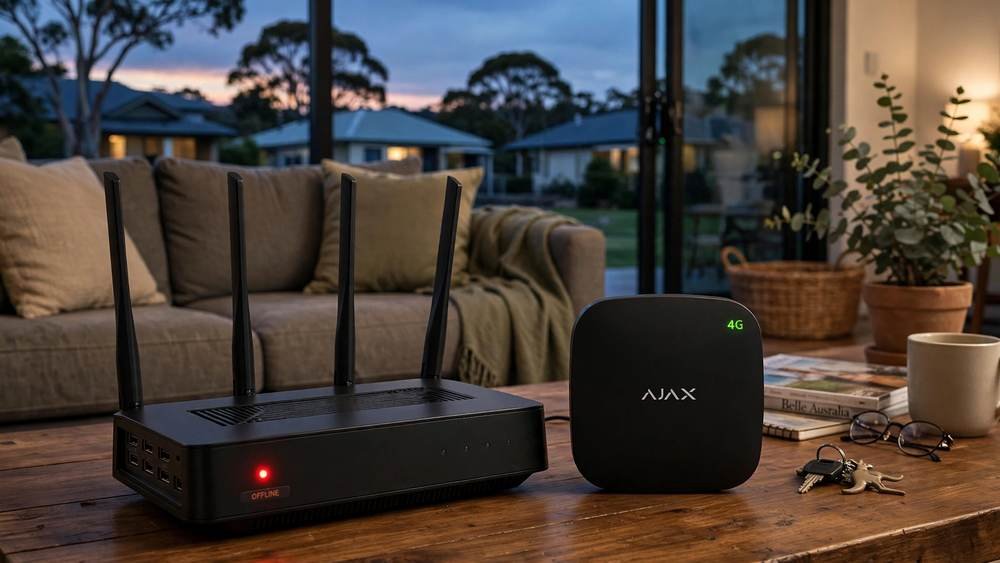
An alarm system internet outage is the failure most households misunderstand. The NBN drops, the modem dies, the router blinks red — and the household assumes the alarm is dead too. It usually is not. The alarm keeps detecting and the siren still sounds. What dies is the reporting: the path that carries the alert to your phone, or to the monitoring centre. This guide covers which path dies, which keeps working, and how to build a system that reports through an outage.
Figures checked on 15 November 2026. Our monitored alarm system guide covers who actually needs 24/7 response, and our wireless alarm system guide compares the kits behind these paths.
What an internet outage does — and does not — kill
Start with what survives. The sensors talk to the hub on their own dedicated radio network, not your home Wi-Fi. Ajax sensors use the Jeweller radio at 868 MHz, well clear of 2.4 and 5 GHz Wi-Fi; Dahua AirShield sensors talk to their hub over their own dedicated radio network too. So if the internet drops out, your alarm stays armed, keeps detecting and still sounds the siren. The internet only ever pushes alerts to your phone.
What dies is the alert. A panel whose only reporting path is IP over the home internet goes silent when the modem dies: the panel keeps detecting, but no alert reaches your phone and no signal reaches the monitoring centre. The alarm itself is fine. The knowledge of it is what goes dark. That distinction is the whole subject of this guide, because the fix is a second path, not a better alarm.
The same applies to cameras, with one difference: cameras and their recorder run on mains power, so a power cut kills them where an internet outage does not. An internet outage leaves the cameras recording locally — they just cannot show you the footage remotely. The alarm’s position is stronger: detection and siren are local, and only the reporting needs the network.
Alarm system internet outage: the three paths, and which one fails
There are three reporting paths, and they fail differently. IP is the cheapest: the panel reports over the home internet, through the modem and router. It dies when the modem dies, when the NBN drops, when the router is unplugged, or when the power goes out. It is the path most DIY kits use, and the path most households rely on without knowing it.
4G is the second: the panel or hub carries a SIM and reports over the mobile network. It survives the modem dying, the NBN dropping, and the router being unplugged, because it never touches the home internet. It dies only when the mobile network dies, or when the panel battery goes flat. CTC Communications lists communicator services at about $38 to $59 plus GST a month, with single- or dual-SIM options and supervised or unsupervised signalling.
Dual-path is the third, and the one installers recommend for an alarm system internet outage: IP plus GPRS together. The panel reports over IP normally and falls back to 4G the moment the internet path fails — automatically, with no button press, no app action, no manual intervention. When the mains power and NBN return, the hub automatically switches back to Ethernet as the primary path and charges its internal battery, and the 4G path remains active as a standby. That automatic switch is the product: the household never has to know the internet died.
Automatic failover: how fast, and how it works
Failover speed is measured in seconds, and the numbers are published. If the Ethernet path fails — NBN outage, router failure, cable cut — an Ajax hub detects the failure within seconds and switches all communication to the GSM path. The monitoring centre sees no interruption: alerts continue to arrive as normal. The switch is completely automatic, and the hub tells you within seconds of any communication loss through a push notification.
The data cost is small. Ajax GSM backup uses very little data — typically less than 100MB per month even with continuous monitoring — so a basic SIM plan covers it. Some installers include a SIM free for the first 12 months with every Ajax hub they install, and offer a SIM plan after that. For whole-of-network reliability, an installer can also set up automatic internet failover for the house itself, so the modem has a second path too.
One caution: the failover is only as good as the paths it can choose between. A hub with Ethernet and Wi-Fi but no SIM has no second path — both its paths die with the modem. Check what your hub actually has: Ethernet plus Wi-Fi is one path with two doors, not two paths. Ethernet plus 4G is two paths. The Ajax Hub 2 Plus has Ethernet, Wi-Fi and dual-SIM 4G in one panel; the Hub 2 has a SIM slot for backup. The Dahua AirShield system takes an optional 4G SIM as backup — supply your own or the installer provides one — and its battery backup keeps the whole system live through blackouts too.
The 3G shutdown: the path that is already dead
One Australian detail decides whether any of this works: the 3G shutdown. Australia’s major carriers have retired their 3G networks, so an older communicator that depends on 3G may no longer deliver signals to the monitoring centre at all. A panel with a 3G communicator and no IP path is a panel with no path — and a monitoring subscription on it is a subscription to nothing.
If you are taking over an old panel, check its communicator before paying for monitoring. The check is simple: ask the installer or the provider what network the communicator uses, and whether it has been tested since the shutdown. A communicator that worked in 2023 may not work now, and the panel will not tell you — it will simply stop reporting, and a monitored alarm that stops reporting is picked up through polling, which is how the centre finds out. Find out first, before the subscription starts. The model number is on the communicator itself, usually on a label inside the panel: photograph it, and ask the provider to confirm in writing that the unit reports on the current networks. A provider that cannot confirm it is a provider whose monitoring you should not buy yet.
Alarm system internet outage: what still works when the NBN drops
When the NBN drops and the panel has a 4G path, everything works: detection, siren, app alerts, monitoring-centre reporting. The app still arms and disarms the system, because the app talks to the hub through the cloud over 4G. The monitoring centre still receives signals, because the 4G path carries them. The only difference is speed: the GSM path is slower than Ethernet, with higher latency, but for alarm signals the difference is measured in seconds, not minutes.
When the NBN drops and the panel has no second path, detection and siren still work locally, and the app still works on the local network if your phone is on the same Wi-Fi — but no alert leaves the house. That is the gap to close: a 4G SIM in the hub, or a communicator module that adds a cellular path to a wired panel. The SIM is the cheapest resilience in home security, and the one most households skip.
The local app is worth understanding properly, because it confuses people in an outage. When your phone is on the same home Wi-Fi as the hub, the app can talk to the hub directly over the local network — arm, disarm, check sensors — even with the NBN down. What it cannot do without the internet is reach you from outside the house, or reach the monitoring centre. So an alarm system internet outage splits the household in two: the person at home can still run the alarm from the couch, and the person away from home hears nothing. The SIM closes that split, and it is the only part that does.
When the NBN and the power drop together, the panel battery takes over: the Ajax Hub 2 Plus holds about 16 hours on its backup battery, the Hub 2 about 15 hours, and a wired panel’s 12-volt battery runs 12 to 24 hours. Detection, siren and 4G reporting all continue on battery. The modem is dead either way, so the 4G path is the only reporting left — which is why battery plus cellular is the combination that survives a storm, and internet-only reporting is the combination that does not.
Testing the failover: unplug the router on purpose
The test takes two minutes and most households never do it. On a Saturday morning, unplug the router — not the panel, the router — and watch the app. A panel with a 4G path should report the communication change within seconds and keep alerting. Arm the system, trip a sensor, and confirm the alert arrives on your phone. Then plug the router back in and confirm the panel switches back to Ethernet.
If the alert does not arrive, the panel has no second path — and now you know, on a Saturday, instead of during a break-in. The fix is a SIM in the hub, or a communicator module that adds a cellular path to a wired panel: CTC Communications lists communicator services at about $38 to $59 plus GST a month, and an installer can fit one on most panels in a single visit. If the system is monitored, tell the centre before you test, or the test becomes a patrol attendance with a bill attached. Write down the result with the date: the failover either works or it does not, and a system whose failover has never been tested is a system whose failover is a guess — and an alarm system internet outage is the wrong time to discover the guess was wrong.
Frequently asked questions
Does my alarm still work if the internet goes down in Australia?
Yes — in an alarm system internet outage, the alarm stays armed, keeps detecting and still sounds the siren, because the sensors talk to the hub on their own radio, not on your Wi-Fi. What stops is the alert: an internet-only reporting path goes silent with the modem. A 4G communicator or a hub with a SIM keeps the alerts coming through an NBN outage.
How does alarm failover to 4G work?
The hub watches its Ethernet path and switches to the GSM path automatically when it fails — an Ajax hub detects the failure within seconds. The switch needs no button press or app action, and the hub switches back to Ethernet automatically when the NBN returns. GSM backup uses very little data, typically less than 100MB a month.
Will my monitored alarm still report during an NBN outage?
It depends on the communicator. An IP-only path goes silent when the modem dies. A 4G or dual-path communicator keeps reporting through an NBN outage, which is why installers recommend dual-path. Older 3G communicators no longer work at all in Australia, so check the communicator before paying for monitoring.
Do I need a SIM card in my alarm hub?
Only if you want alerts and monitoring to survive an internet outage. Without a SIM, the alarm still detects and sounds the siren locally, but no alert leaves the house when the NBN drops. Some installers include a SIM free for the first 12 months with an Ajax hub; after that a basic SIM plan covers the small data use.
What is the difference between IP and 4G alarm monitoring?
IP reporting runs over your home internet through the modem — cheap, fast, and dead when the modem dies. 4G reporting runs over the mobile network through a SIM in the panel or hub — it survives the modem dying and the NBN dropping. Dual-path uses both, with automatic failover between them, and is the arrangement installers recommend.
Figures checked 15 November 2026 from Alltronic, Mr Secured, PROCCTV, Sipko Security and Connect and Protect. Planning figures, not quotes. External price source: Mr Secured Ajax alarm systems, Brisbane.